Feeds:
Posts
Comments

Archive for the ‘Bear and Thistle West’ Category

It’s been a good week of projecting, I’d say. 

This photo, taken yesterday around 4 pm, captures the end result of a lot of really hard work.  Yes, that is a wine glass in my hand.  I am celebrating, and trying to get the knot behind my right shoulder blade to relax.  Not only is the first wall now at full height, but the terrace bed it contains is now cut back into the hill full width – five feet, plus another foot for where the second wall will lay. 

That’s a 35-foot long wall, plus the rounded corner.

My next step is to order the block for wall #2 and get it moved down onto the first bed, which will be my work surface until the next terrace is complete.  Then, once I’m done tromping all over it and the blocks are well-tamped and settled, I’ll remove 16″ or so of the granite fill in this first terrace and replace it with a topsoil/compost mix for some serious vegetable gardening.

But first, I’m enjoying an enormous feeling of accomplishment, and letting my bones rest.  However, do not be alarmed at the tonnage of concrete and dirt moved and the manual labor involved; I work slowly and steadily and pay particular attention to ergonomics, keeping loads low and close and engaging core muscles before every lift.  And I take lots of rest breaks.  So other than being stiffer than usual and this darned knot behind my right shoulder, I’m no worse for the wear after working like a mule for the past week.

Surprisingly enough, moving the block around was not the most grueling part of this job.  If you look to the left of my head in that first picture, you’ll see a pile of plant material perched up on the top edge of the hill.  It doesn’t look like a huge pile, but let me assure you, it is. 

If you will compare the first picture taken when I started this project to this post’s picture, you will notice a lot of the ice plant that used to cover this hill from top to bottom has been cut off and removed.  It looks all neat and tidy now, like I just sliced it off with a laser beam and Poof! it went away.  Oh how I wish. 
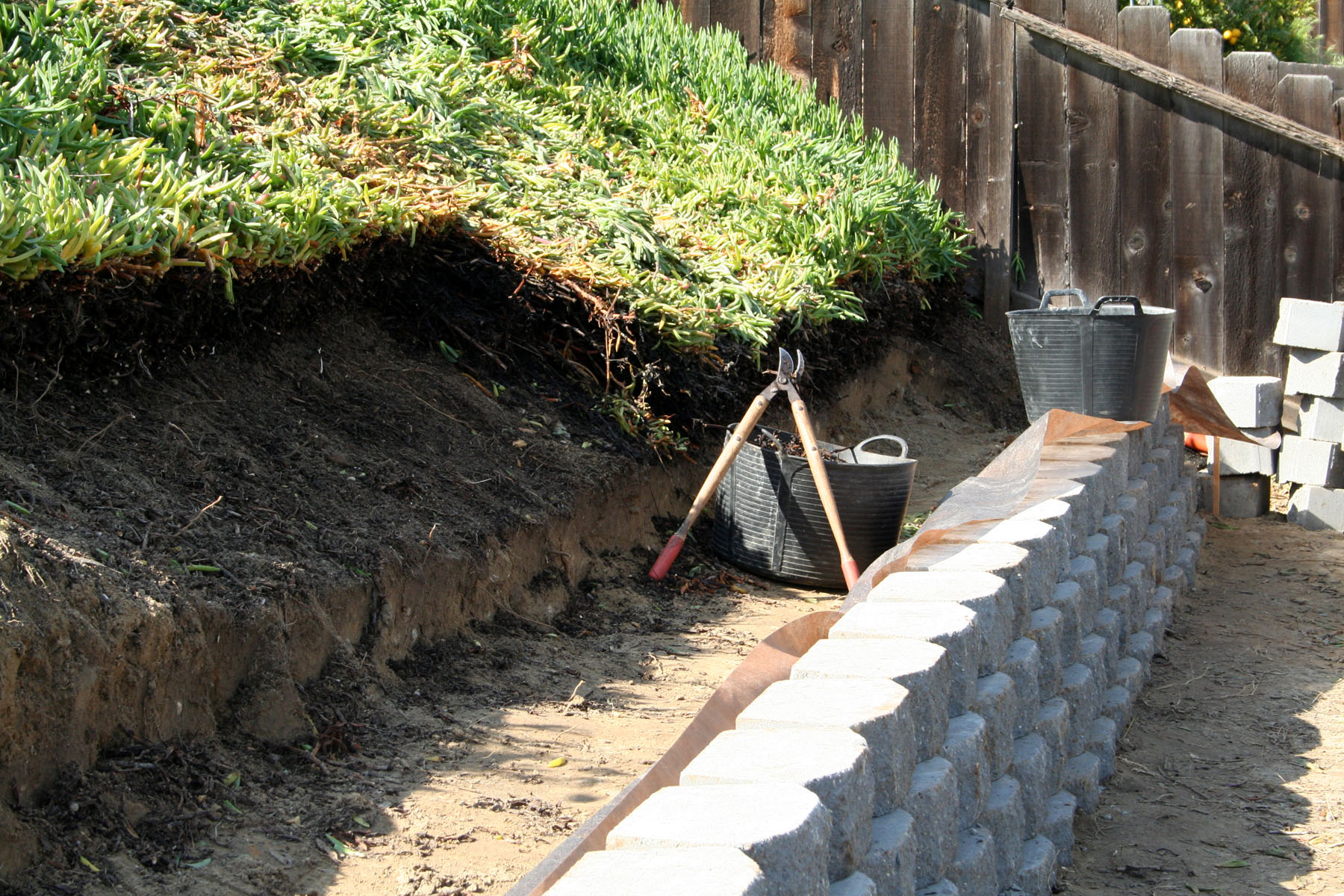
Left undisturbed for more than a decade, the ice plant was thriving atop a foot-deep layer of partially decomposed older plants; the leaves had turned to crumbly black humus, but the stems all needed to be cut somehow.  A swath at a time, with the help of my trusty loppers and my indespensible garden trugs, I got ‘er done.  One trug-load at a time cut, pulled, and trudged up to the top of the hill.  My legs feel like I climbed Mt. Everest.  And my arms are pretty darned tired, too. 

Really now:  with leisure-time activities like this, who needs a gym membership?

Read Full Post »

This is one of those projects I’ve wanted to tackle for a long time.

All the backyards along our side of Redlands Place perch atop the rim of a spacious and wild chaparral canyon, with half the property in back of the houses comprising a rather steep hill that merges into the hillside below.  Most of our neighbors have installed pools or decks to extend their back yard space; from the beginning I planned to terrace our bit of hillside into garden beds, to take advantage of the south-east exposure.  But there were challenges.

The previous owner had planted two bunches of invasive pampas grass in the bottom corners and a variety of ice plant (also very invasive) along the remaining slope.  The pampas grass had grown into impenetrable tangles of vegetation nearly 20 feet across at the base that took many hours of labor back in 2002 to remove.  Since then I built a rough-hewn set of free-form concrete stairs to the bottom level for access, but with the exception of removing the pampas grass clumps, we’d done nothing to improve the hillside.

But the time has finally come to tame the hill.  My container garden that takes up half the flat part of the backyard needs to expand into a permanent home, and I need room to stage materials for the fence rebuild project.  So energized by my project plan, I inhaled deeply, took measurements, and ordered enough interlocking block to build the bottom wall for the first terrace bed.  The block and half-yard of gravel was delivered Friday, amidst pouring rain and occasional hailstorms.  My goal is to complete the first retaining wall before we leave for our Kentucky farm trip on 6 Feb.

Here is what the hill looked like before I started:

The brown line of dead plants across is the ice plant I pulled out about a month ago, that had grown down from the bottom of the stairs to the fence (out of the picture at the right) at the bottom property boundary.  In one year.   Ice plant is a very vigorous, succulent invasive from South Africa, growing up to a meter in one season and rooting anywhere a stem touches the ground.  Since it needed to dry out a little before running it through the shredder to make into compost,  I threw it uphill as I pulled it.  This current project started with pulling all that half-dried material down to the bottom, and moving it laboriously up the stairs to my utility yard one forkful at a time, where the huge mound of it awaits an afternoon’s work with Chewie, my stalwart Troy-bilt chipper-shredder.

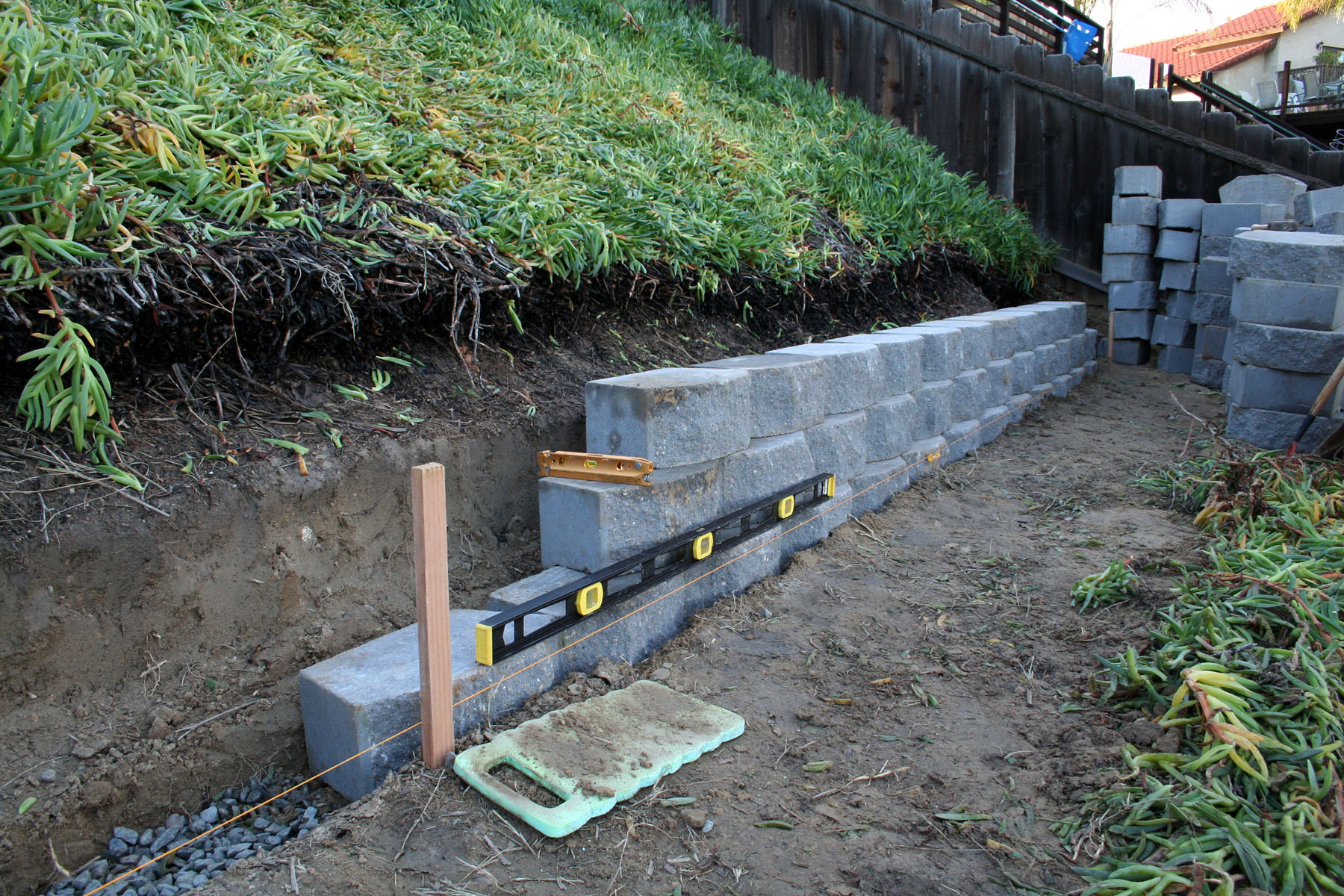
160 Keystone Legacy block will build a 35-foot long, 3-foot high wall.  I spent the afternoon and part of Saturday morning imitating a small draft animal, first carting trugs of gravel down to the bottom and then 4 blocks at a time on my garden cart from the driveway to the edge of the hill in the backyard.  I’d already dug the footer trench for the wall (see first photo) and laid a couple of block when I realized I needed to somehow get all of them down to the bottom before I could really start serious wall building.  So Sunday morning, that is what I did.

My method was what I’d call “ghetto.”  One woman, 160 blocks needing to be moved down 20 feet of ice plant on a 45 degree incline.  Carrying them down the stairs one by one was out of the question.  So I gerry-rigged an old half sheet of plywood backstop against the chainlink fence at the bottom, padded the whole affair with prunings of ice plant, and started rolling 55-lb blocks like bowling pins.

It worked.  No blocks were damaged in the making of this blog post.  And at $3.50 apiece, that’s a good thing.  Man, it was a lot of work, though.   I managed to get three at a time rolled down without hitting each other, then had to clamber down the spongy bed of ice plant to stack them safely out of the way, and climb back up to the top for another round of ghetto block bowling.

After a bit of rest, Sunday afternoon I started laying the first course.  This is the most important element of the wall, these first blocks; they must be perfectly level or everything above will turn out badly.  Following instructions, I laid a couple of inches of sharp gravel down, then set the block.  Ever laid flagstone or brick?  Levelling on a bed of sand is tricky at best; on gravel, near impossible.  So, I cheated a little and used a bit of decomposed granite fill dirt overtop the gravel, to get the level right. 

It’s turning out well.  I’ll backfill with gravel and lay weed-barrier cloth before pulling the dirt down as the courses go up.  More ice plant removal will be required.  Lots of compost to be made, hooray. 

Garden beds are dancing like sugar plums behind my eyelids.  I can’t look at that hill without seeing all three terraced beds completed and a marvelous Spring garden emerging from the compost-enriched soil.

Read Full Post »

Things are getting busy here at Bear and Thistle West.

It finally sunk in over the holidays that my time here is short, and if I don’t plan things out I will never finish all the projects I’ve been wanting to do before I have to leave. 

The truth is (and I’m ok with this, really), if I don’t do them, they won’t get done.  Things like painting the house inside and out, replacing the falling-down back fence, rebuilding the termite-eaten pergola over the back patio, re-laying the cracked flagstone pathways over concrete, re-insulating the attic.  Stuff that needs done before the house is sold, several years down the road – basic material condition items that will ensure it gets a fair price and we’ll get as much equity out of it as possible.

Quite a lot of work, you might say, and you’re right.  But I’m loathe to pay someone to do a job I can do myself, and I actually like building and fixing stuff, so I’ll hire out only the most difficult tasks and perhaps the ones I cannot get to for lack of time.

We bought this little stucco and tile roof house nearly 11 years ago, long before I figured out I was a farmer and needed more than an eighth of an acre to be happy; until 4 years ago I thought I had years to tackle all the basic material improvements any 25-year-old residence needs.  After two long deployments and much time on the road, my projecting window is now a mere 22 months long.

Yikes.

So, the time has come to do some serious planning.  And I found just the thing:  a Gantt chart on Google Docs that I can access anywhere, and update and modify as I go along.  It took a few days to populate, and I’m sure my time estimates will need to flex as projects unfold, but what a great help it is, to be able to map out a proposed schedule over the next two Springs, Summers, and Winters (and one Fall), lining up outside work with long daylight months and reserving inside work for winter months.

Will I get it all done?  Maybe, maybe not.  But check it out – I am certain to accomplish more with a plan that lets me focus on one project at a time, knowing that “all that other stuff” will have its time; and the incentive of keeping to a schedule is just the motivation I need to use every little scrap of time gainfully, whether I’m able to stick to the project schedule or not.

I’m stoked.  And I love being stoked.  It’s one of my favorite feelings in all the world.

Project #1, Attic Decking and Re-insulation, evolved into a two-phase job.  It kicked off with the installation of a pull-down attic ladder done back in November, something I’d threatened to do for years, to make the house attic accessible for plumbing repairs and future ventilation upgrades.  Every time we had to drag the ladder in from the garage and climb up through the little access hole, I swore, loudly.   

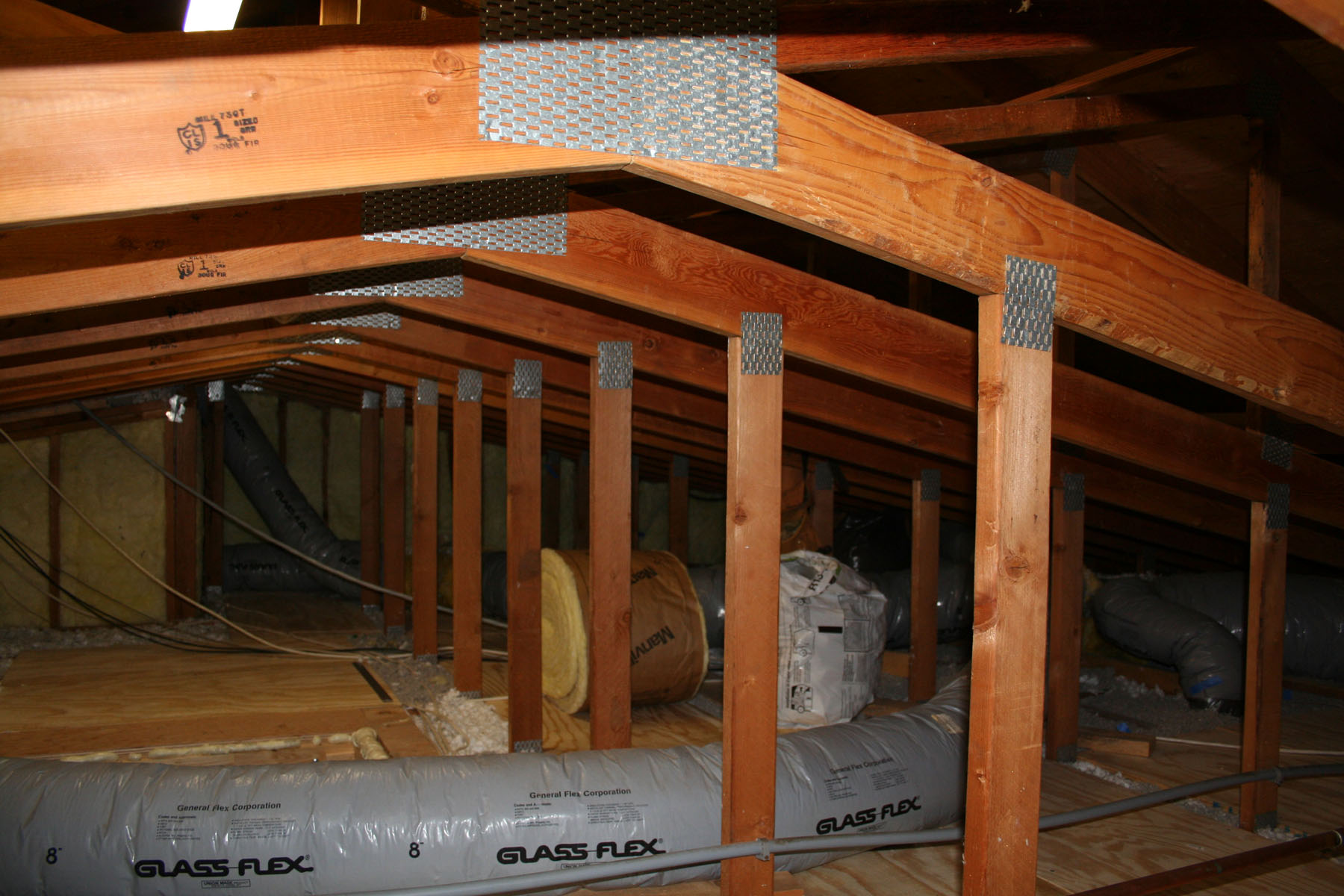
The ladder had to be framed in offset of the ceiling joists to center on the hallway; a pain in the neck to say the least.  Bear was a great help with the sawzall and demolition, leaving the framing of the opening to me, and we teamed up to get the ladder hung, one person above and one below.  After I hung a couple of fluorescent lights from the trusses I could see where to lay down plywood decking so we weren’t just scrambling around on joists and rafters, and it quickly became apparent that the blown-in insulation was pitifully inadequate. 

So after the holidays I started the decking in earnest, which required adding more insulation, one section at a time, moving about on hands and knees or ducking under the waist-high truss members.  6 sheets of plywood sawn in fourths and five bales of cellulose insulation later, I have a fine storage attic, all holes sealed with foam, plenty of space to walk around, and insulation restored.  The cathedral ceiling portions of the attic, though, still need work.

Which will be Phase Two, done at a later date, because my Project Chart has me starting the back hill terracing and retaining wall construction this week.  I’d like to get that done so my Spring garden can go in those new growing beds, which will open up the backyard for the summer’s fence rebuilding project.

It’s good to have a plan.

Read Full Post »

It took a fair bit of self-discipline to pick the first pound of peas (just enough for two servings) and save them for shelling and cooking, instead of eating them like snacks right off the vine.

But it was so worth it.

This is a first for me; I’ve never grown English peas in my backyard garden, so I’ve never tasted the incredible sweet freshness of lightly-steamed new peas next to my steak and baked potato.  Let me tell you, it was heaven.  I could not believe my taste buds.

Thankfully I planted a second crop to follow this one, so we’ll have peas all winter, if all goes well.  I’m stoked.

Read Full Post »

Well, as wintry as it gets for Southern California, anyway.

Wind and a bit of rain, and 54 degrees, is all we San Diegans need to get in the holiday spirit.  Lacking (and not needing) a woodburning stove, we’ve got a tidy fire in the fireplace tonight, and with the tree finally decorated, the house is finally starting to feel Christmasy.

I am glad I’m not travelling, stuck in an airport because of snow delays.  My sympathies for all who are; that is no fun at all!

My work schedule is light this week, and I’m enjoying the extra time at home.  Cooking, baking, cleaning, decorating – not much time for just laying around, that’s for sure.  Still, it’s worth it, and beats the heck out of where I was this time last year.

Even though this holiday season snuck up on me, it’s great to be home this time of year.  Hope your holidays are warm and bright!

Read Full Post »

 The weather-guessers called for another band of rainstorms through here, beginning yesterday, with rain anticipated to fall off-and-on through Sunday.  It’s drizzling now, with hope for as much as an inch in the next couple of days.

My little backyard garden will appreciate that, especially if they are right about the winds being absent.  Monday’s deluge with 40-mph gusts nearly knocked my peas out of their roots.  I tied them up when I looked out and saw the lovely ladies all bent double over their trellises, and they made it through intact with no lasting damage, but I’m sure it was stressful to be blown about like that.

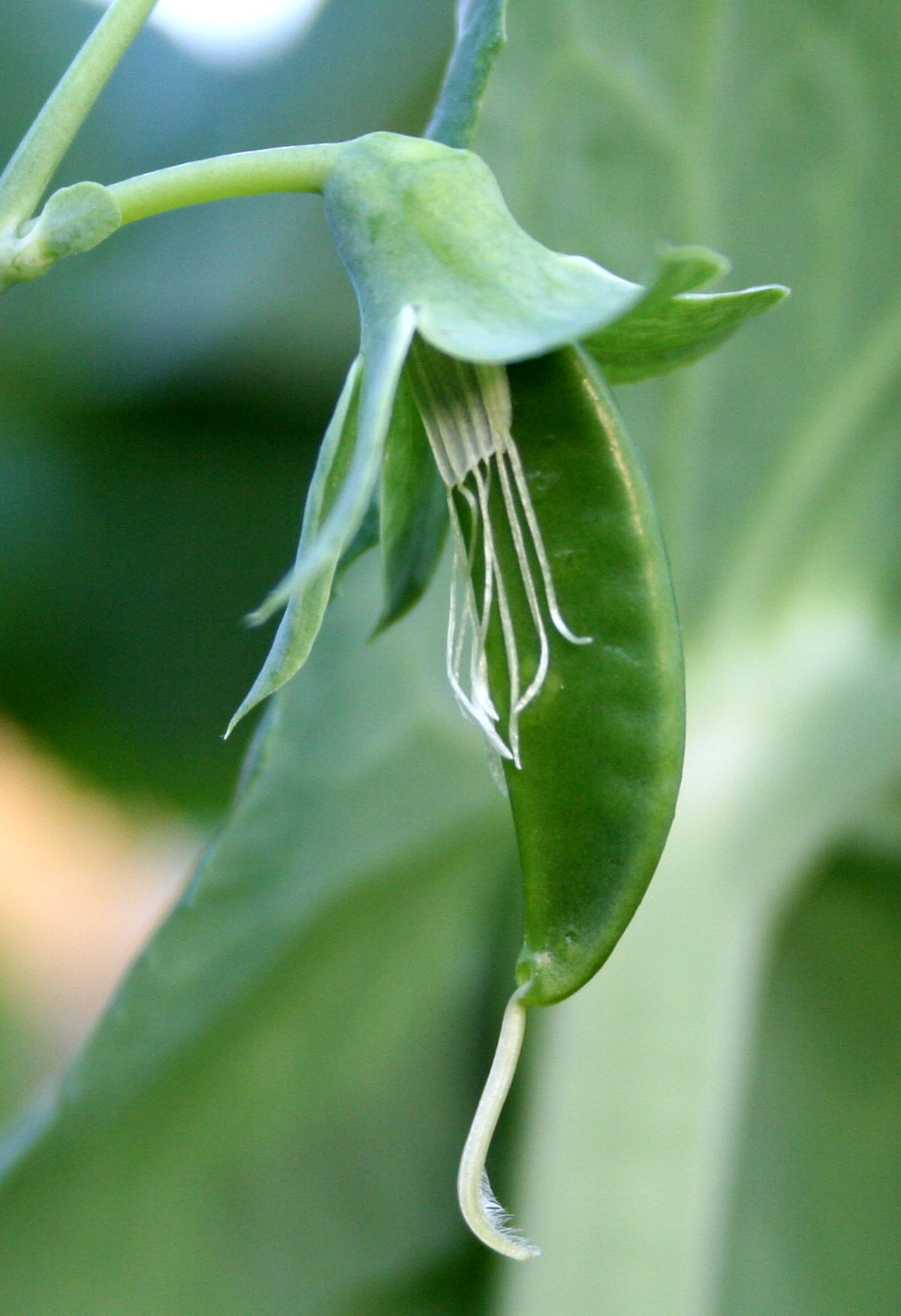
The peas are organic Green Arrow English Peas, from  Heirloom Seeds, first time I’ve grown these.  They dig the cool temps and made good growth despite the short days, climbing to 4 ft high before dressing themselves with jewel-like white flowers.  Now, tiny pea pods dangle like miniature ornaments, promising sweet treats to come.

Gardening in a Mediterranean climate in the winter months is quite extraordinary.  It’s a lot like having a second Spring, with shorter days of course.  I shall miss the luxury of growing brocolli and brussels sprouts, peas and lettuce and scallions, beets and kale, through December and January.  A better gardener than I could have a continuous supply of edibles for the dinner table with nary a gap in harvests, with careful planning and year-round succession planting. 

As it is, I lose track of time, forget to start the next round of seeds, and we suffer the occasional short hiatus from ultra-local, organic home-grown food.  But peas are on their way, two plantings spaced 3 weeks apart, the leaf lettuce is filling salad bowls twice a week already, and I have high hopes for my happy brassicas.

It’s raining lightly but steadily tonight, and the garden is soaking it up.

Read Full Post »

This post breaks new ground for me.  

My week at the Acres USA Eco-Farming conference was both life-changing and reaffirming, and made me realize that everything I do, even here in suburban San Diego waiting for the retirement bell to ring so I can head to Kentucky and get started, is about my farming.  The story has begun, and this part of it, this preamble to the Great Beginning, needs telling too. 

For some reason, up to this point I thought my posts had to be about the farm, or strictly farm-related, in order to be relevant to this blog.  Having told my story to dozens of fellow farmers, I’m seeing it differently now.  My journey to the farm is the current chapter, which includes everything I’m doing here in suburbia to make the transition to farming in Kentucky.  I’ve even taken to calling my curbside homestead “Bear and Thistle West” because it is in all ways my West Coast farmhouse on 1/8 of an acre,  where we eat food grown and cooked by hand, preserve the harvest overflow, make soil, manage rainfall, and build skills and collect tools needed for farming.

The reality is, I am a farmer, whether I’m here on Redlands Place in Bonita, CA or on Knifley Rd in Elk Horn, KY.  At the rate things have been going, these last couple of years will fly by like birds trying to beat the winter weather; every day, then, I am trying to do something that brings me closer to starting my farm.  So I’ll write about that.

As for the conference, my brain couldn’t have taken another day of lectures and workshops; there was so much good material, so many good speakers.  I’ll discuss the high points as I find time, as I have several posts drafted and will work on them as I can.  The conference wrapped up Saturday evening and I escaped the frozen north in the nick of time, heading back to Bear and Thistle West just before the vicious winter storm plowed across the Midwest, closing freeways and causing havoc for travellers. 

Yesterday we finally got a taste of what passes for winter weather here in SoCal:  heavy rain and wind, terrific gusting wind.  My high-tech rain gauge – a widemouth pint mason jar – measured 2.5 inches, quite a lot for this area, and much needed.  It’ll knock down the fire danger for awhile, and the moisture is appreciated by yards and gardens, and farms, too.

Yes, farms, and close by, hallelujia.  Seems we have a new start-up, a local organic CSA farm south of San Diego, nearly on the Mexican border.  I stumbled across Suzy’s Farm website by accident and was delighted to read that they have a farmstand, since my winter backyard garden is just getting going (we garden all winter long here at 32 deg lattitude) and I’m always looking for good organic vegetables.  So I called, and Rodrigo said no, the farmstand wasn’t open, but come on by the warehouse, I could buy there.

So off into the pouring rain I went.  Looking for carrots to juice, mostly, but ready for just about anything.  And as it turned out, carrots weren’t picked, but they had lots and lots of every other thing.  I bagged two bunches of chard, two bunches of long beets, a handful of those lovely purple-necked scallions, a bag of round zuchinnis, a pumpkin (for pie), a buttercup squash, and six cabbages.  Yes, I said six.  Cabbages.   For sauerkraut, of course.

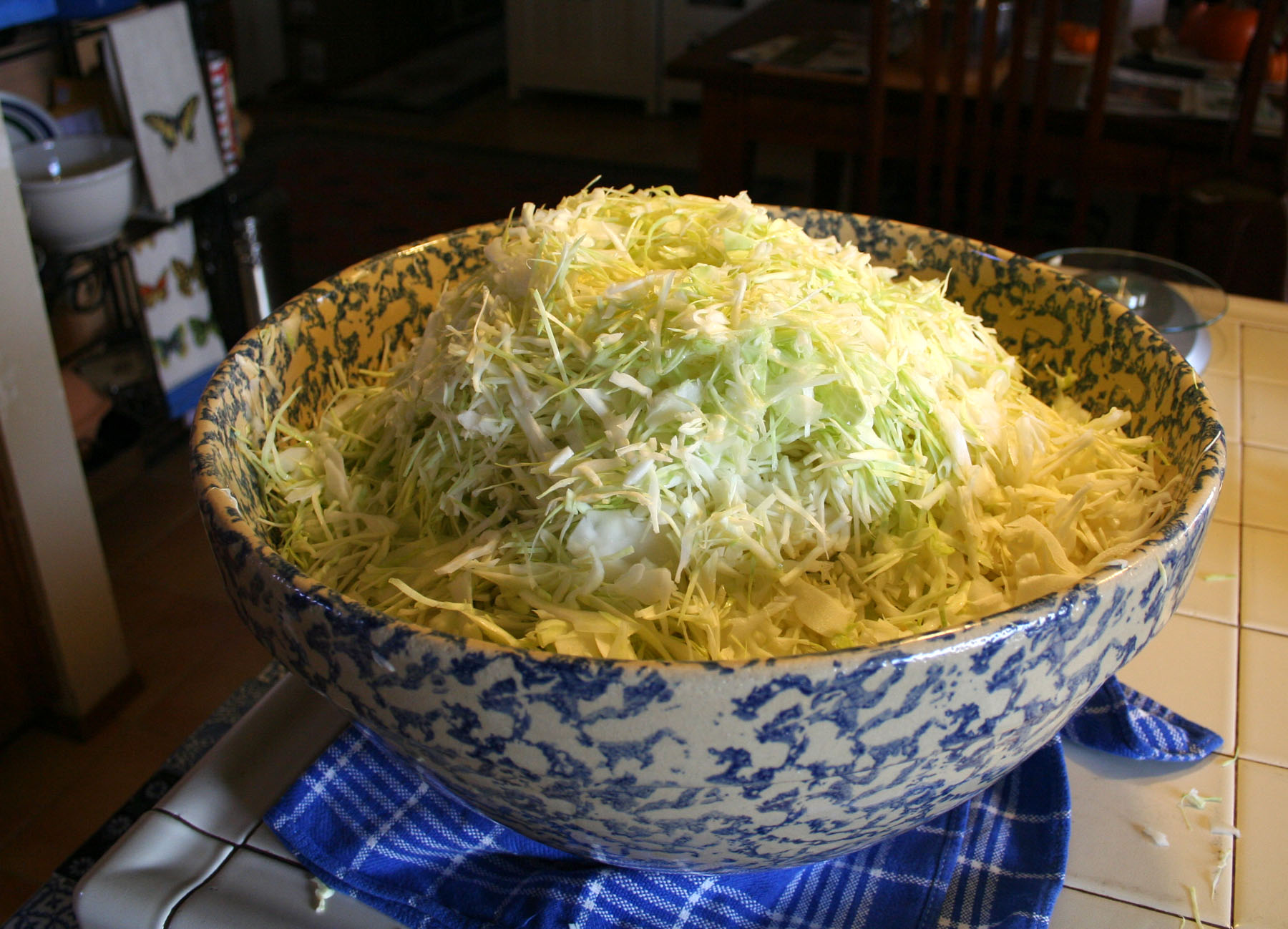
It’s been a long, long time since I’ve made sauerkraut.  Like, 25 years, give or take a few.  I still have my old 5-gallon ceramic crock, which serves nicely for brining turkeys but hasn’t seen a leaf of cabbage for years.  This time around, I had the help of my trusty food processor, which made the shredding of 20 lbs of cabbage a very simple task.  Absolutely nothing to it.  And the giant ceramic bowl I bought in a Fallon, NV feed store, thinking a bowl that large would surely come in handy some day, was just perfect for salting and mixing the mounds of shredded cabbage. 

My hands ended up being the packing tool of choice, and now the crock is filled with kraut, covered with brine and weighted down, and we’re waiting for fermentation to start.  Some books say it will be finished in 3 to 6 weeks, others note that the flavor gets more complex the longer it goes, and 6 months is not too long.  I can’t remember how long my first batch developed, so it’s like I’m doing this for the first time. 

I believe I’ll sample a little over the New Year’s holiday, and pair it with whatever clean meat I’m able to find.  Now if I could only find a local farm that raises pastured pork!

Read Full Post »

« Newer Posts