Feeds:
Posts
Comments

Writing The Plan

I must get better at blogging in the present; September’s fence-building trip was ages ago, and I’m still not done writing about it, but there are other things Farm-related that are newsworthy.  Which is the whole point of keeping this blog, so we’re moving on.

You’ll hear about the Big Pencil Sharpener another time, then.

We had a six-month extension to file our taxes this year because of my deployment, and so October was all about sorting through receipts and filling out my Form F, accompanied by more research and reading of tax law relating to sole proprietorships and farm businesses.  Lots of reading.  And finally, the light went on.  Like smelling the proverbial cup of coffee, I got a strong whiff of exactly what I need to do in my particular situation, which is to take concrete actions toward making my farm business a reality.

So, I’m wrapping up an eight-week online course on Writing a Successful Business Plan, and although The Plan is a long way from actually being written, I have the tools and skills I need to write it,  know what research needs done and what needs to be included in it.  It’s a daunting task but, broken down into separate elements, quite doable.  And so I’ve begun.  I’ll share bits and pieces here, as I draft my mission statement and drill down into the details of setting up a grass-fed livestock enterprise.

I also took a huge leap and booked arrangements to attend the Acres U.S.A. Farm Conference in St. Paul, MN.  I fly out on Monday, to attend a two-day intensive pre-conference workshop on livestock systems entitled “Full-Circle Grazing Managment – Cow, Soil, Management, Grass”.   Learning from and meeting experts like Jerry Brunetti, Gearld Fry, Greg Judy, Neal Kinsey and all the rest will be a life-changing experience, I’m sure, along with the opportunity to meet like-minded farmers in all stages of production. 

Should be an amazing week, and I’ll try to journal it here as it unfolds.


Plumbing the hinge post

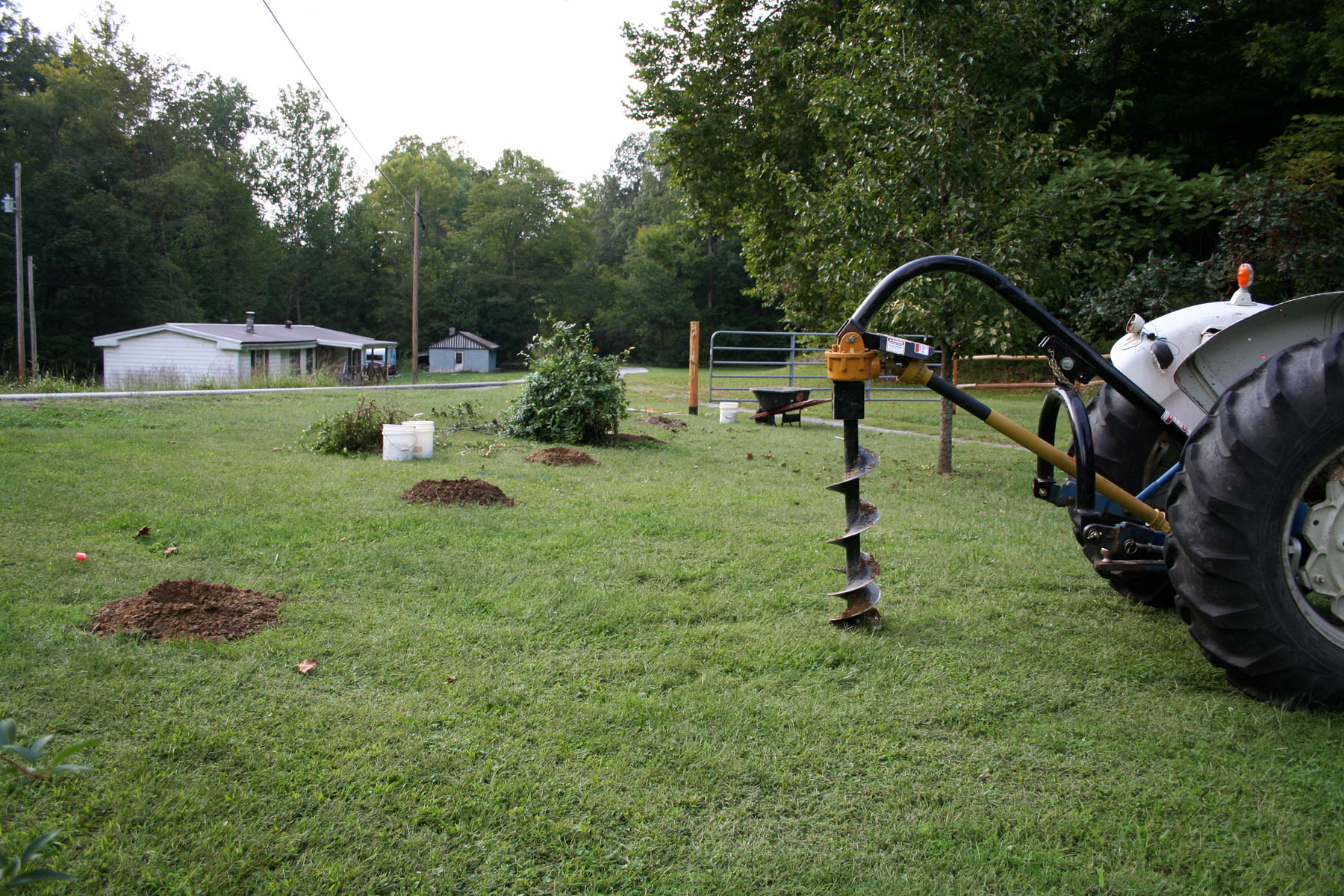
We dug 12 post holes in all; four large enough for gate posts, eight fencepost-sized.  Not by hand, of course, or at least not entirely by hand.  The PTO-operated posthole digger with a 9- and a 12-inch auger did most of the work, but Kentucky Jack digs postholeshas its share of rock, which resisted the machine’s auger tip and had to be busted out by hand.  The old-fashioned way, with the tools you see here, and lots of elbow, back and arm grease.  Once the buried layer of rock had been punched through, the auger was able to finish the dig.  I’d say of the 12 holes, only 3 were uncomplicated by a 4-inch layer of rock that lies about 12-inches beneath this area.

A few lessons learned:

1) Lining up post holes is easier said than done.  Check them after they’re dug by propping the posts up in the holes and stringing a line across their tops, if you want the fenceline to be straight.  We measured and flagged every one, but they all had to be adjusted before the posts were set.  Posthole diggers are not precision instruments.

2) Body weight helps when using the spud bar to break rock.  Get the guy to do that part.

3) Don’t even think about digging postholes or setting posts without a spud bar.  Tool of choice, nonpareil.

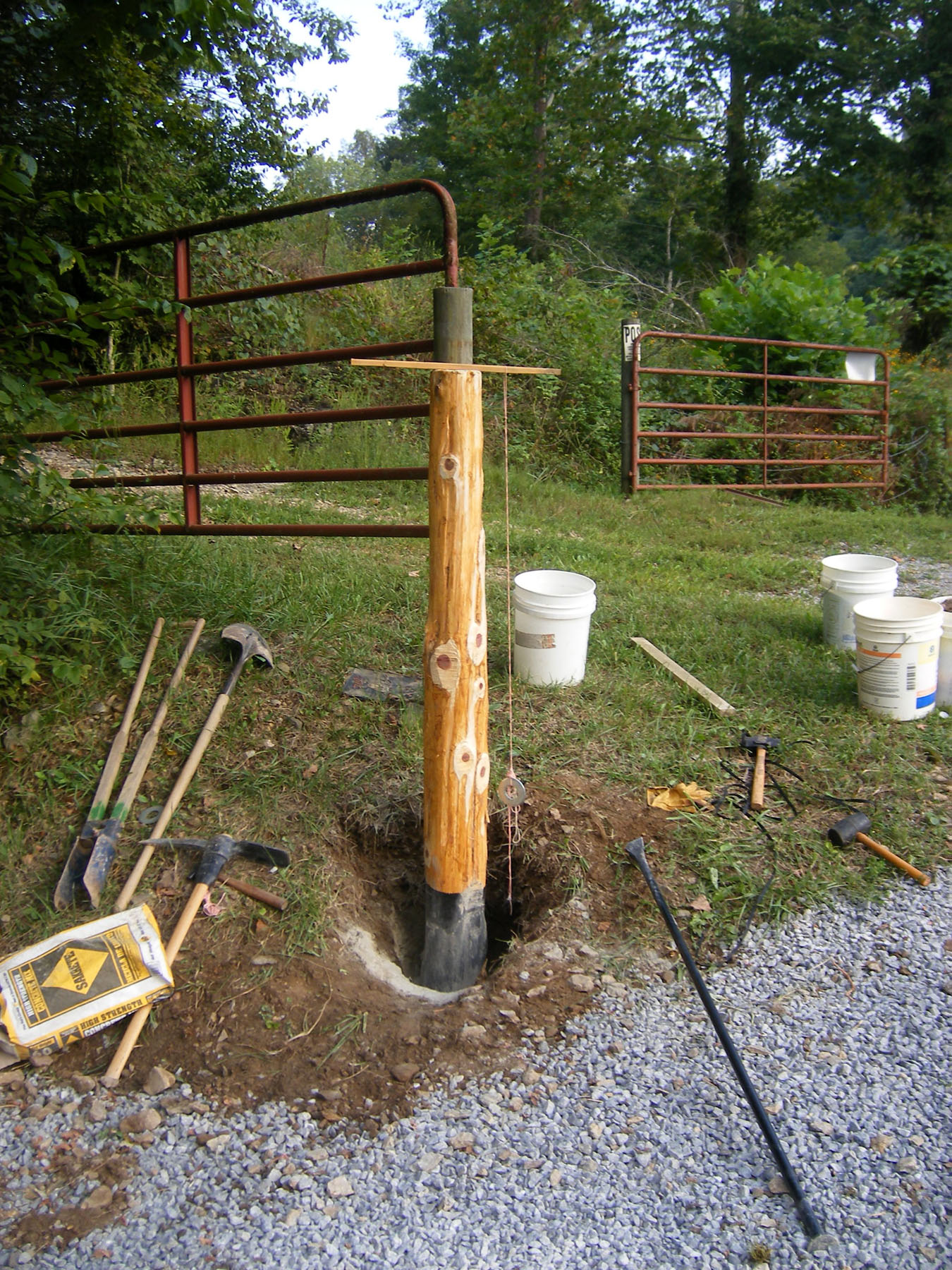
As for plumbing the posts, the approach varied from the textbook version of using a level since our posts weren’t milled perfectly uniform from top to bottom like store-bought posts would be.  Cedar trees taper and are larger at the bottom than the top – how to plant a post plumb then?  Skidder had the solution, learned from prior experience; a stake laid across the top of the post with a line and plumb bob hung from the end gives a vertical reference through the post’s center.  Viewed from two different angles 90 degrees apart ensures a perfectly plumb post.  Worked like a charm.  I’ll plumb all my posts this way from now on.

farm fence and gates

many ways to peel a log

Spud bar work

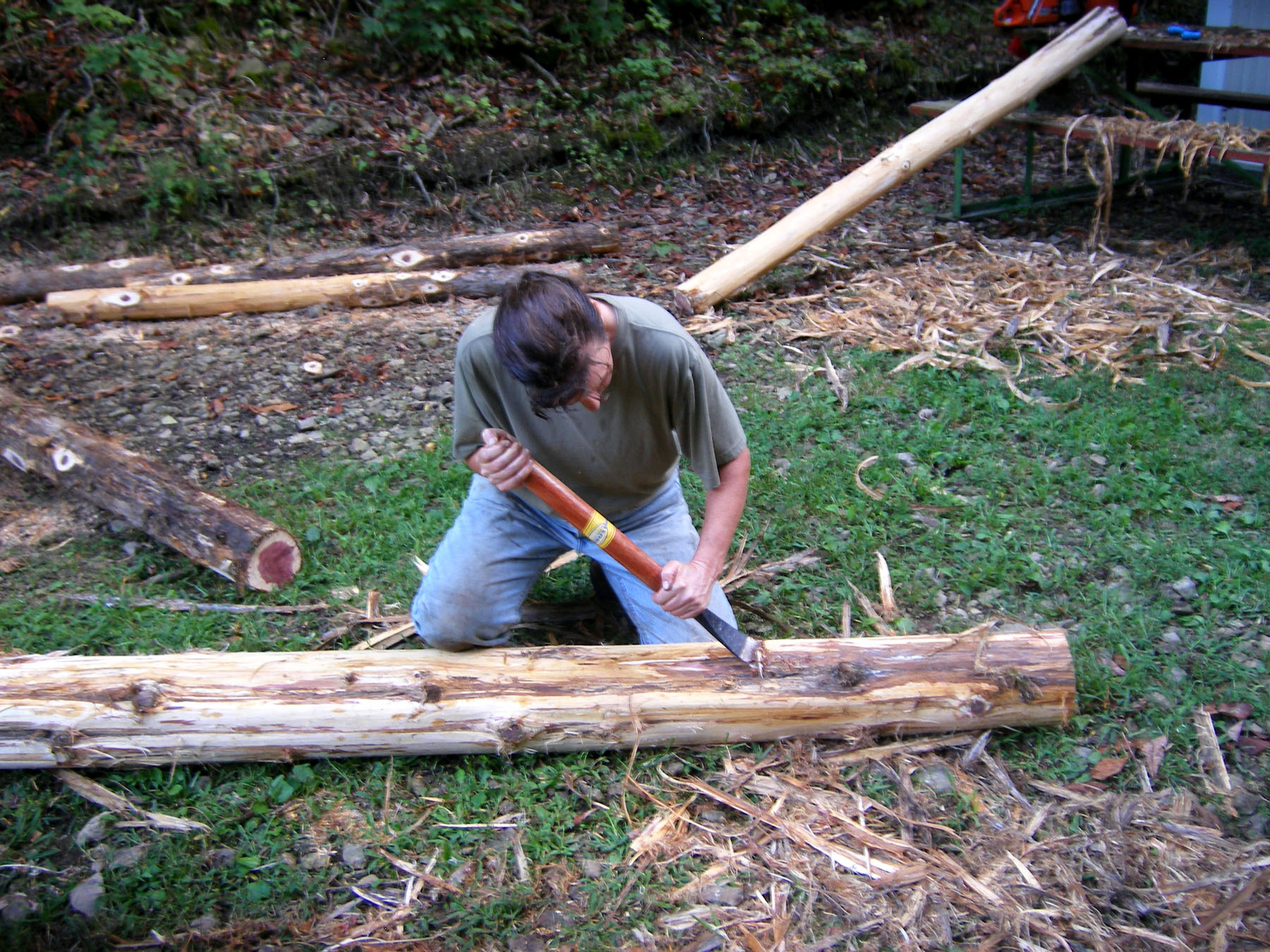
While planning September’s fence building project last summer, I decided early on to try and use materials cut from the property, and knew I’d need tools to peel logs.  I didn’t know exactly what I’d be up against, so I bought an 8-inch drawknife and a short-handled bark spud, thinking what one couldn’t handle the other maybe could.

They were the perfect tools.  I got lucky, really, getting one of each, as the drawknife couldn’t get into the flutes of the cedar logs like the bark spud did, and using the spud alone would have been murderously slow.  But together, between Skidder and I, we peeled logs like we’d been doing it our whole lives with those two tools.  I was very pleased with how they worked out.

Was it hard work?  Depends on what you consider to be “hard,”  but yes, we worked up a sweat.   Was it slow work?Peeling posts  Again, it depends on what you compare it to.  We caught on pretty quickly and learned how to position the logs against a sturdy picnic table, and let the tools do most of the work instead of our backs.  The last couple of rails I peeled went much faster than the first two.  We weren’t putting up hundreds of feet of fence, so peeling the logs and rails by hand wasn’t a show-stopper for the limited amount of time we had; I’d say it was neither slow nor fast – just right.

Alene and Bobby got back from their trip to Oklahoma two days before we left, so Alene came out to the shop one morning to watch me finish peeling the last of the rails.  By this time I was getting pretty handy with my little drawknife, and thought I was working along at a pretty good clip with very little wasted effort, but I guess that’s all relative, as her only comment was, “You’d think there would be an easier way to do that.”

I just smiled and kept peeling.

Buttoning up for Fall

hilltop pastures in fall

I will finish the fence-building story soon, I promise.  First though, an update from last week’s trip out to the Farm to button it up for the season ahead.

It was a very short trip:  only a day-and-a-half to transfer utilities, set up and program the inside lights, visit the bank and the Farm Bureau offices, put up some outside signage and secure all the gates, and set the alarm.  I arrived late Thursday night, and got everything done on Friday and Saturday morning except meeting with a guy to talk about mowing the grass around the house and down by the road next summer; he didn’t show at the arranged time, nor did he call, which tells me he wouldn’t have been reliable.  I’ll find someone else. 

I am pleased to report that you wouldn’t know the house is unoccupied unless you read it here.  The lights and radio come on and turn off in the morning, and again in the evening, including porch lights, and in a random enough pattern not to look like they’re on a timer.   Anyone driving by on the state road wouldn’t notice a bit of difference between now and when the folks lived there.  The place looks cared for, inhabited, and snug. 

With only a few precious hours left before I had to hit the road for Louisville to catch my return flight,  I headed up on foot Saturday morning to lock the gate at the top of the road, and check on things up top.  The trees were turning, not flamboyant this year, but colorful enough.  It was a drizzly, blustery day with grey skies, not ideal for landscape photography, so I snapped a few quick pics with my point-and-shoot Olympus and stomped on back down the hill after making sure all the equipment tarps were still secure.  Glad to have a few moments, though, to experience the changing season up on the pastures.

A flurry of last-minute details crammed my final hour at the farmhouse:  shut off water, turn heater all the way down, flip circuit breaker for water heater, turn down fridge and freezer.  Then it was out the door, set the alarm, drive out the gate and lock it for the last time, and a quick detour up the hill to touch base with my next-door-neighbor Mike, whom I’d not met yet.  Pleasant surprise, to find him watching TV with Clarence, my eastern-boundary neighbor, whom I’d not yet met either; we stood and talked a few minutes, long enough to exchange phone numbers and gain an instant friendship with both of them.  Mike will mow the grass next summer, and Clarence offered to bush-hog the pastures if I can’t get to them. 

Both men assured me they would keep an eye on the place and walk over and check things out once a week or so.  Call anytime you need anything, they both said.  We shook hands, exchanged good-bye’s and I hit the road for Louisville, grinning a little, and feeling very fortunate.

fence from trees

fence posts almost

Building a fence out of your own trees isn’t the easiest way to do things.

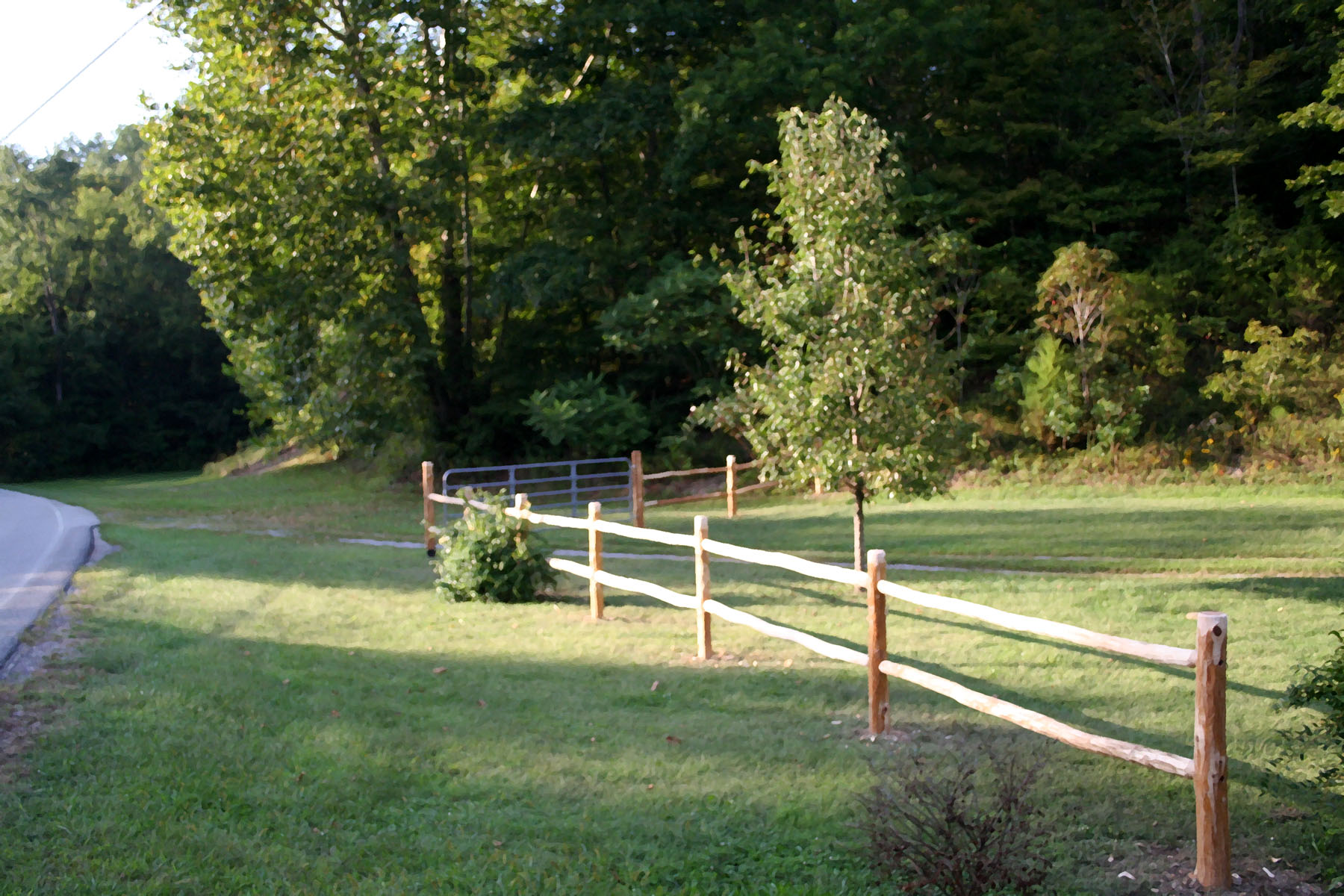
 My li’l ole fence out front along the road has garnered many compliments because it looks damn nice, and really stands out among the pressure-treated, milled lumber, commercially-installed versions in the area; but its true beauty in my view is its humble, local origin.   And that it was built by my own hands.  From my own trees.

Most folks around here probably think that viewpoint’s a little off.  Too much work, nicer materials right down there at Lowes; why go to all the bother.  I admit, it would have been much easier just to call someone out and pay them to slap something up.  It would have met the minimum objectives as well, which was to keep vehicles from driving up to the house and shop building, thus making the place more secure.

But it wouldn’t have been a thing of beauty, or have the potential to last 25 -30 years like this one will, or given me any of the satisfaction I’ll feel every single time I lay eyes on it and remember how we built it from cedars and hardwoods cut off the hill above. 

Arguments for saving time and effort aside, I’m just not interested in paying someone to do work that I enjoy doing and can do well myself, especially on a project that designs itself as it goes; nor am I at all keen to buy mass-produced, trucked-in, chemically-treated materials when I have raw materials in abundance in my own backyard.

Sounds a little pious, perhaps too idealistic, I suppose.  I will readily admit that this commitment to doing my own work and using my own materials as much as possible has its drawbacks, not the least of which is the multiplication of effort and time in any project equation.  But I’m pretty stubborn, and not afraid of slow, hard work, and so I accept that building something from scratch means doing things “the hard way” with hand tools, sometimes, and a great deal more effort than needed with “modern” methods and commercial materials.

I may not be able to take this approach every time.  The porch, for instance, was built with pressure-treated lumber, after much thought and deliberation about the pros and cons of using non-treated lumber in that climate for that type of application.  But my pasture fences will need to be non-toxic, in the big scheme of operating a certified organic farm, and so this small section was a test bed for my ideas of how to use locally harvested, untreated posts in the Kentucky soil without compromising on fence longevity.

What I didn’t know before Skidder and I took that first walk up the hill to survey for materials, was that I had a good number of mature eastern red cedar trees (Juniperus virginiana) at their climax of growth potential, having been overtaken by taller hardwoods and fairly begging to be made into fence and gateposts before their wood began declining as they lost the battle for sunlight, water and nutrients.   And while this tree is not a true cedar, but a member of the juniper family, it does have superior rot-resistance – especially in the red heartwood – not as much rot resistance as black locust, but more than any other hardwood species I might have had to use.

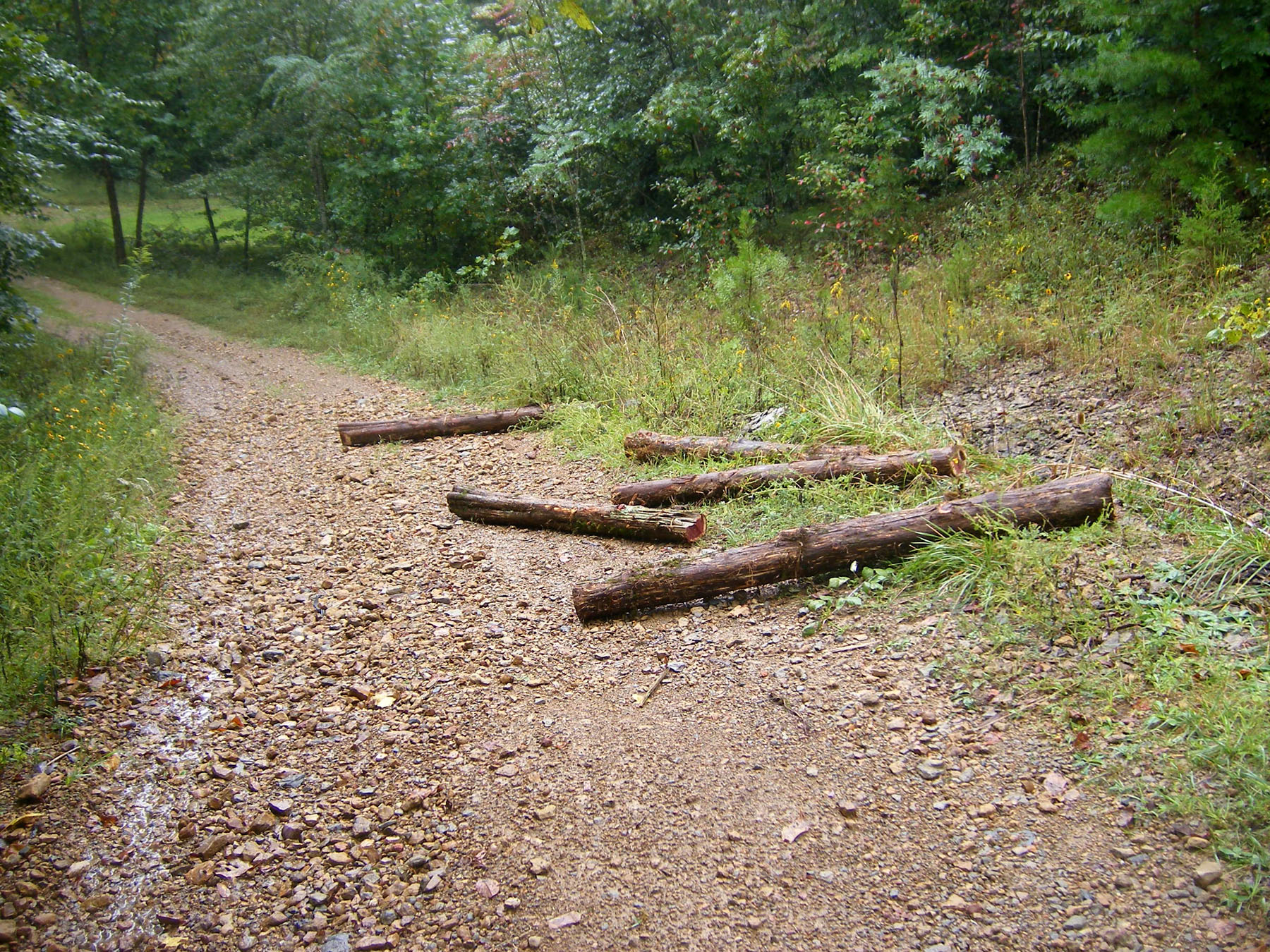
We took four 8 – 9″ gate posts and nine 6 – 7″ fence posts off the south-facing hill just around the corner from the shop.  I believe I felled a total of eight trees, for the posts.  One was quite large, leaving me a lovely 10-foot timber that will make some fine slabs for sign-making and bench-building.  Skidder pulled most of them down the hill by herself while I cut.  We worked furiously in the morning rain, thinking it might go on all day and wanting to get the logs down to the shop so we could peel them inside.  But the rain stopped as we finished, which wasn’t a bad thing. 

Next:  peeling with spud and draw knife.

Progress, unreported

Fencing crew and fence

September, nearly over now, was stacked to the rafters with doubled-up activity; a month that should have been two, in all fairness.  It goes that way sometimes.  I dove in headfirst beginning in early August, planning the Farm trip and project, chasing endless details that shifted priorities like dune edges in the wind, trying, as they say, to keep my eye on the biggest alligator closest to the boat.

Added complexity sprang from the background of an increasing workload at the squadron, fueled by end-of-fiscal-year deadlines and requirements.  It really wasn’t a good time to be away for 10 days, but the timing wasn’t flexible for what needed done.  And so we got it done, and done well, but my reporting of it languished horribly.

Thank you Jeff, for checking in to see if all was well and asking for an update.  I am long overdue.

The fence and gate in the picture above are not the whole story but they represent the satisfactory completion of what we set out to do this visit:  make the property secure for the periods of time we will not be there.  It is good we stuck with this objective, as Bobby and Alene made one more trip out to Oklahoma while we were at the Farm, bid on a house while they were there (telling us nothing about that as usual, until weeks later when their offer was accepted) and have finally, finally, decided to move completely out of the area.  Apparently Alene’s desire to be closer to her kids and grandkids won out over Bobby’s preference for remaining in rural Kentucky.  And so it goes.

My sister found time to travel out from Colorado to help me with the fence and gate project, five working days the likes of which I’d not experienced in quite some time.  We were determined to have both gates and at least a section of fence up before she had to leave, and worked like monsters from dawn to dusk – my gratitude is unending for her contribution of time, talent, and extraordinary effort.  Lord knows I could not have gotten the job done without her help.

For the fence and gate posts we found good-sized cedars in abundance on the south slope just up the road from the shop; I cut and she skidded, earning the nickname Skidder in my post-trip photo captions, and so Skidder is how you’ll know her here.  She brought her camera too, so we were able to capture most of the project from start to finish, from laying out the postholes to hanging the gates and building a log rail fence from my own trees.

My better half pitched in with the breaker bar on some of the gnarly holes – Kentucky has more than its share of rock – and helped me punch the six postholes for the stretch of fence alongside the road; but his major contribution was culvert maintenance, both on the road up the hill and at the driveway entrance to the state road, where July’s flash flood had washed things out and nearly buried the culvert to the creek. 

(One of the great surprise discoveries about my husband is his affinity for running a shovel.  You wouldn’t know it to look at him, you’d think he’d be allergic, but he’s taken on this culvert maintenance thing with an impressive level of initiative, for him.  I do not argue, I praise.  And happily go about my building projects, asking for an extra hand only when absolutely necessary).

The house and shop now has an alarm system installed, with a loud siren that goes off when it’s activated, as well as a monitoring service that calls the local Sheriff as well as my cell phone.  We accidentally tested that feature when Derril showed the folks how the system works; he set it off without calling the monitoring company and a cruiser with a big burly deputy showed up in five minutes.  Nice feeling, that.  I apologized and assured him we would call first next time, but it was good to know the response will be there if and when it’s needed.

I will have to make a quickie trip back out mid-October, once the folks have moved out, to set up the inside timed lights, set the alarm, make sure the gates are all locked, and transfer the electric service over to my account.  Since it’s a rural electric coop, I have to apply for membership in person, and I didn’t get that done this last trip.   Bonus for me:  the leaves will be turning, a sight I’ve never been there to see.

I mentioned pictures and this report is only a snippet of all the fun we had; you can see them all on Flickr by clicking on the “more pictures” link at the right, at the bottom of the B & T Farm Photos strip – then select “sets” on the top of my Flickr page, and look for “Farm gates and fences.”

I’m also going to rework the farm website’s  project page (see A Farm of My Own: Bear and Thistle Farm, at right) and post a detailed description there with photos, as it was a huge learning experience for me and I was delighted with how all the tools performed.  This blog post would be enormous if I were to lay it all out here.

More to follow, then.

Bobby on the zero turn

I’m not opposed to change.  I think I have by this time figured out that it’s part of life, and not always predictable.  I’ve learned to willingly adapt to change, to shift my priorities and efforts towards whatever new direction lies ahead as a result.  But doing so takes time, me being a plodder and all, and I prefer not to be interrupted by more change before I’ve finished responding to the first wave.

 So the latest news from the farm is actually a blessing, but it left me shaking my head for a couple of days, amazed how things can shift so quickly.

The folks called Friday last week, a month since they’d first dropped the bombshell about wanting to move to Norman, Oklahoma where their daughters and grandchildren live, to ask if it would be ok for them to stay put, instead.  They have changed their minds, and decided they wouldn’t be happy there.  At least for the time being.

We could have told them that, but it wasn’t our place.  They figured it out themselves, at their own pace.

All the reasons why we thought it would be unworkable for them came tumbling out as they talked over each other on the phone:  they can’t find the kind of place they are looking to buy in that area; the dogs, used to roaming the mountain, would have to live in a tiny back yard; they don’t like the kind of people there, there’s not enough open, “country” space, and Bobby would get bored not having anything to do outside; and they like their Kentucky doctors, like living in Kentucky.  Dear old Bobby must have said “I just wouldn’t be happy there” at least 10 times during the fifteen-minute call.

Well hello, McFly.  After driving 13 hours back from their Oklahoma visit, Bobby toted the luggage in the house then hopped onto the Toro mower for a couple of hours to mow the grass, which wasn’t overgrown by any means.  He just couldn’t sit still.

Precipitating this latest change, as it turns out, was the renewed possibility of their buying the little property down the road, since the property line issue that had derailed the purchase has finally been resolved and the current owner still needs to sell it to finance the new house he’s already broken ground for.  Now that the property isn’t listed, he and Bobby are discussing terms between themselves, and if he’ll let it go at the same price (he had to buy back the front yard from the state road department as a result of the survey), Bobby and Alene want to go ahead with their plans to buy the place and fix it up a bit at a time while living in the little farmhouse at Bear and Thistle.

They were worried we’d already made arrangements to have someone move in immediately, and wouldn’t be able to accomodate their request.  But we hadn’t, so it was easy to say yes of course, you’re more than welcome to stay on.  They were relieved to hear that and of course we’re relieved, too.  It’s much better to have them there.

We will go ahead with installing the alarm system and a few motion-activated security lights, and I will gate and fence the driveways and as much of the road edge as possible on our September visit.  We don’t need to make it Fort Knox, but I’ve put too much planning and resources into that initiative to turn it off at this point, and it will make the place more secure even with them there.  So they’ll not see the woodstove installed for their benefit this winter, and perhaps not the next, for having zig-zagged course and forcing me to change our working plans to adapt to the possibility of having to leave the place unoccupied. 

But they are lucky to have had the flexibility to try their idea on and, finding it not fitting, go back to the original arrangement.  And we’re fortunate they changed their minds, though I have no idea how long they’ll want to stay, or if they’ll change their minds again soon, or if their plan to buy the little house down the road will work out.  

I hope it does.

farm gate

The place might sit empty for awhile. 

I am in favor of this idea, because it’s my farmhouse when I’m there, several times a year, but not for leisure purposes:  I need a homebase to work hard out of, to be able to get up at the crack of dawn and be outside by 7 am, work until dark and stop to make dinner only after projects are buttoned up for the night. 

I do not want to camp out at some hotel room 12 miles away and have to wait until my late-sleeping travel partner gets rolling so we can drive to the farm, starting my workday before 10 am if I’m really lucky and with nowhere to take a break and prepare a meal to eat, while some stranger lives in our house.  Silly, impossible idea, that.  I tried the sock on several times and it never fit. 

(This is actually my mental image of how I approach the difficult task of choosing between possible scenarios like this, I see it like trying on a sock.  Pulled it on and the damned thing was too tight, and scratchy, and would have caused me unending distress.  No kidding.)

 So, a shift in project plans for the September working visit, from installing the wood stove to: 

1) Building good sturdy gates across both driveways (one to the shop, one to the house, separated by the creek).

2) Fencing the road boundary between and past the gates to prevent access to the buildings. 

3) Having a monitored alarm system installed in house and shop (I would want this when I move there by myself anyway, working up on the hill all day, out of earshot of the house by the road). 

4) Installing an inexpensive x10 lighting control system inside house, to turn lights and radio on and off, simulating occupancy. 

5) Installing solar-powered security lighting on house side of creek, and in back of shop. 

6) Putting deadbolts on all doors.

I contacted the realtor that sold us the place, who’s been working in the area for several decades and lives just a few miles down the road – wanted to know what her experience was with folks renting places out vs. leaving them buttoned up and whether there was any such thing as property management in the area.   She related a couple of horror stories about clients who ended up having to sell a secondary residence after getting tromped on by unsavory renters who trashed the place and were difficult to evict; just too few good people needing a place to live that will take care of it like you’d want them to.  

Her recommendation was to implement the above security measures and she even offered to make frequent checks on our place as she drives by there weekly, and call us if anything appeared amiss.

It’s a risk I think I’ll take.

There is a possibility that my sister in Colorado will move out to the farm and caretake the place, after the next ski season is over.  A fortuitous opportunity for her to change location and jobs and get something of a fresh start.  But nothing etched in stone yet, just a possibility.  So we’ll proceed with the security measures, plan for the worst and hope for the best.

farmhouse front door

We’ve been very fortunate to have Bobby and Alene stay on and take care of the place after they sold the farm to us in January 2006.  They were comfortable in the little double-wide mobile home they’d put on a foundation down by the road; they liked the area and the climate and hadn’t decided if they would move back to Florida, where Bobby’s grown children live, or Oklahoma, where Alene’s daughters and their families have settled.  Bobby enjoyed working outside, mowing the yard area around the house and cutting the pastures, and keeping an eye out for fallen branches on fences and that sort of thing.

But he’s nearly 73, with arthritis and diabetes and now a newly-rebuilt knee, and the work has become too much.  Last winter when he wanted to cut those two hickory trees down for firewood, that he really didn’t need, I should have told him no.  I thought he knew his own limits and the work of it would make him happy.  But it was too much.

They’d made an offer on a little place just down the road, but the survey turned up a boundary snarl that couldn’t be resolved – the property line ran right through the living room and though the state road department said they’d transferred rights to the little slice long ago, no one could be certain, and the survey remains in dispute.  So that hope was dashed, a pity, since they were looking forward to fixing up the place a little at a time while living at the Farm.  They like their doctors there in Campbellsville and didn’t really want to leave, but time is running out for them to find a smaller place to build their last nest.

So the trip they made to Oklahoma to visit grandkids and great-grandchildren while we were working at the farm resulted in a change of plans for them.  They’ve decided to move in with her daughter there while they look for a place, but will stay on at the farm through September, when we were planning to return to install the wood stove, to give us time to make other arrangements.

We’re very grateful for the three years of caretaking they gave us.  Of course we covered all expenses and paid Bobby extra for the pasture mowing, and did everything we could to keep them comfortable and happy.  Installing the wood stove was to ease their worries about losing power in the winter; the place is all-electric and they had no way to heat or cook during long power outages.  They hadn’t had any yet, but it worried them.  And building the back porch took priority because of Alene’s falls.  Both improvements would have been done eventually anyway, but the point was to meet their immediate needs first. 

I’m a bit relieved to be able to postpone the wood stove installation this Fall.  I’ll focus my time on giving the pastures a final mowing, get the corral panels painted and stacked under cover, and the place ready for winter. 

We’re not sure what the plan will be now.  It was good to have someone living in the house, but we stay there on our frequent visits and renting it out would make that impossible.  Keeping the house and shop secure is the main concern; the yard area will need regular mowing next summer but I can hire that out.  And I can keep up with the pastures as well as Bobby has, we’ll plan our trips around that. 

This may be a good opportunity to see what kind of neighbors we have.  I’ll keep an open mind.

all grass

Our 20 acres of hilltop pasture that Bobby reclaimed from the encroaching forest some fifteen years ago are doing well, despite the lack of grazing animals.  They were cleared and reshaped with a bulldozer back then, and seeded to orchardgrass and ryegrass, that he could remember.  The forage cover I observed our first year of ownership was mixed grasses and forbs – low value weeds, mainly – none of which I could yet identify with any precision, with an occasional easy-to-recognize clover volunteer and a goodly number of invasive black cherry seedlings gaining ground.   The forest always tries to come back.

 In many areas the cover was thin and enough bare ground showed on some of the slopes to merit beginning a pasture improvement program right away.  Since we bought the farm in 2006, the hay harvest has been mowed and mulched twice a growing season, returning as much of the organic matter as possible to the soil where it can build tilth and add nutrients.  I also disced and overseeded perennial ryegrass and red clover two years ago, to fill in thin spots and improve the nitrogen profile; the clover took well and should remain vigorous for another couple of years, and the ryegrass has added complexity to the mix of established grasses.   A pasture walk while I was there in early June confirmed the stand is thick, the bare areas have filled in, and the clover-sown areas look just right.  But a major problem remains.

The primary cool-season grasses found in our area pastures are orchardgrass, bluegrass, some timothy, a little ryegrass, and tall fescue.  Though there are good stands of orchardgrass at the pasture edges, and a wide variety of different grass varieties can be seen throughout, the tall fescue predominates.  It does this naturally, being a vigorous perennial bunchgrass that forms a tight sod, out-competing other species for sunlight and nutrients, and it has an unfair advantage, as well. 

Most tall fescue is infected with an endophyte, a fungus that lives inside the plant cell walls and enhances the fescue’s vigor and survivability, making it a highly-productive forage plant.  This was the characteristic that caught Dr. E.N. Fergus’s attention when he visited a farm in Menifee County, Kentucky in 1931 and observed an impressive tall fescue growing on a mountainside pasture.  Dr. Fergus took seed from that hillside back to the University of Kentucky and subsequently tested and released the ‘Kentucky 31’ variety of tall fescue in 1943, which was vigorously promoted by the University’s Extension Agronomist and widely accepted by Kentucky farmers.  During the next two decades there was great interest in and planting of ‘Kentucky 31’ throughout the lower Midwest and much of the South, as this new variety was more vigorous and better adapted than other cool-season grasses available.

It was not the great grass they thought it would be, however.  Palatability to livestock was disappointingly low, and performance of animals grazing it suffered, though no one knew why.  Cattle grazing fescue would sometimes go lame, referred to as “fescue foot,” and would also more often exhibit an unthrifty condition in the summertime, called “summer slump,” eating less and having difficulty staying cool.  In horses grazed on fescue, reproductive performance was especially affected:  pregnant mares often aborted, or carried too long and had difficult births; foals were sometimes stillborn, and milk production inadequate.  These toxic effects of fescue on horses and cattle were observed and recognized, but the cause was not known and remained a mystery for many years.

Research finally revealed in 1976 the source of the toxicity:  the fungus Acremonium coenophialum, an endophyte that grows inside the fescue plant and produces alkaloids that protect the grass from insects and nematodes, making the plant more tolerant to marginal soil environments and poor conditions.  What is good for the grass in this case is not good for the grazers:  the alkaloids are the cause of “fescue toxicosis,”  which negatively impacts feed intake and heat regulation for cattle and causes serious reproductive problems in horses.  

Nearly 80% of the fescue in Kentucky pastures is infected with this endophyte.  So most, but not all.  And new varieties have been developed that either have no endophyte, or have a less toxic one instead.  But the endophyte-infected fescue (E+ fescue) is persistent and vigorous and once established, is difficult to eradicate.  It can be done, but it usually involves chemically killing the entire forage stand, planting a smother crop, re-killing any remaining fescue, then re-seeding an alternate variety.

Or, the percentage of E+ fescue can be reduced and controlled by cultivating and overseeding/interplanting clovers and other grass varieties, suppressing the seed-producing stage by mowing (the endophyte propagates through the seed), and grazing at early stages when the endophyte is at lower levels (stems and seeds contain the highest levels of toxicity).  With careful management, a grazier can drastically lower the percentage of infected fescue, rebalancing the forage mix so other varieties predominate, and do much to minimize the negative effects of any remaining E+ plants.

Since I’ll be grazing and making hay for both horses and cattle, I’ve been especially concerned with determining how much fescue is in my pastures, not an easy task if you don’t know your grasses.  I’m learning them, slowly, and the fescue seedtruth has been disappointing, as it has become clear I have lots of fescue which means I have a lot of work to do before the mares will have adequate pasture.  Clicking on the picture in the previous post, those graceful side-bending seedheads you see, all fescue.  Yes there’s some ryegrass there as well as a nice clump of timothy in the right foreground, and at a different time of year other grasses are in growth and the fescue is not center stage.  And I haven’t had it tested yet to see what level of infection it has. 
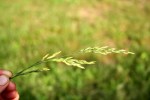
But it is a beautiful, thick, healthy stand of mostly tall fescue I can safely assume is toxic enough to worry about.   Since I’d rather drink a gallon of Roundup than chemically burn the diversity and micro-life that is my pastures,  I have my work cut out for me.  Nothing done well and with care is quick and easy.