Feeds:
Posts
Comments

June working visit

hilltop hayfield in june

Our ten days at the Farm in late May/early June were work-filled and blessed with mainly good, clear weather.  It is a pity I was not able to cut the pastures, as the ground was fairly dry and we had a week with no rain; it has rained regularly since we left and they may not get mowed until well into July.  But we had other things to do, and Bobby can mow when things dry out again. 

The folks took the opportunity to drive out to Oklahoma to visit family, meet a new great-grandaughter, and get away from the Farm for a bit.  With us there to look after the dogs, it was as simple as jumping in the truck and driving West.  We appreciated having the place to ourselves for the week; we enjoy their company but when we’re there to work non-stop on specific tasks, it’s nice to set our own meal times (supper usually waits until after dark, past nine) and not have to explain what we’re doing and make conversation as we fly in and out of the little house.  At least for me, that’s the benefit.  My type-A dawn-to-dusk work practices are not always easy for laid-back retired folks to understand.

I had every intention and was well-prepared to tackle two projects this visit:  building steps for the back door to replace the unsafe stack of cinderblocks that Alene had tumbled down once already, and repainting and moving to storage the rusting corral panels that once served as a stock handling pen.  The cinderblock stoop was completely inadequate and the corral, 20 panels or so, is placed too close to the Big Pond and has been weathering unnecessarily, unused since 2002.  I will set it up in a better location as a round pen for training the horses, when that time comes.

The back door steps idea morphed into a full-blown porch, a 6′ x 10′ deck with two wide steps and a sturdy railing porch building finishedcapped with 2 x 8’s, built strong and solid on four posts embedded in concrete footers with a concrete pad at the base of the steps; safe, roomy, useful, enduring.  And beautiful, I think.  It took me 9 days to finish, from digging the footer holes to putting the last coat of stain on the deck.  Halfway through the week I realized my pace was slower than I’d planned, and the corral panels would have to wait another year for their sanding and new coat of green Rustoleum paint.  But doing something well is always worth taking your time.

Derril left me alone with my carpentry project and worked on digging out culverts and drainage ditches on the road up to the hill.  He also replaced the kitchen faucet and fixed a few problems around the house.  Carpentry is not really his thing, and I will admit I work better by myself on projects like this where I am learning and figuring things out as I go.  So he worked at his pace and I at mine, and we were both pleased with what we accomplished on this trip.

mel_and_J_in_garden_008GOD SPEED THE PLOUGH
(from an old English cup)

Let the wealthy and great
Roll in splendour and state.
I envy them not, I declare it.
I eat my own lamb,
My own chickens and ham;
I shear my own fleece
and I wear it.
I have lawns; I have bowers.
I have fruits; I have flowers.
The lark is my morning alarmer
So jolly boys now,
Here’s God speed the plough.
Long life and success to the farmer.

 _______________________________________________________

No, that’s not a plow behind that horse; it’s a drag harrow.  And no, that’s not me, that’s Mel driving “the ‘J’ mare” as Jason calls her, working the garden on Ridgewind Farm.   But I stumbled across the poem the same day he sent the picture of Mel and J, and for that reason they go together in my mind.

“God speed the plough, ‘a wish for success or prosperity,’ was originally a phrase in a 15th-century song sung by ploughmen on Plough Monday, the first Monday after Twelfth Day, which is the end of the Christmas holidays, when farm laborers returned to the plough. On this day ploughmen customarily went from door to door dressed in white and drawing a plough, soliciting ‘plough money’ to spend in celebration. “Encyclopedia of Word and Phrase Origins” by Robert Hendrickson (Facts on File, New York, 1997).

I found the poem on Hollin Farms website; another good Virginia farm worth taking a look at.

Spring Green

Oh what a difference a month makes.  The trees are finally wearing their fresh new leaf outfits, unblemished yet by insects or dust, and the view heading up the hill past the garden/barn spot is now an emerald rhapsody of dappled greens kept sparkling like jewels by the steady spring rains.  I am curious to know what wildflowers have bloomed and gone by the time we get there in late May. 

There’ll be time enough in the near future, I know, to explore for myself the myriad inhabitants of Kentucky forest, creek and meadow as each season takes center stage; for now I must content myself with doing homework, learning what I can from books and the internet to identify grasses, trees, weeds and flowers I am as yet unfamiliar with. 

My native landscaping knowledge was of High Country western flora – Colorado, Utah, Nevada, Arizona.  As a twenty-something citizen naturalist I knew every shrub, tree and flower around the northern Rocky Mountain region by their proper latin names and common tags as well; now I am an illiterate pre-schooler as I walk through my fields and forest, yet to learn the alphabet, much less read the book of diversity that surrounds me.  It will come, though, in time, that familiarity.

Two weeks from now I’ll be in this picture, clad in muddy work boots and  jeans, doing farm work in the warm May sun.  Two years from now will be the last Spring on the farm I’ll have to miss in its entirety, the last time I’ll ever have to wonder what mystery wildflowers spring to life on the forest floor in the month of May in south-central Kentucky.  Time enough, ’till then, to read and learn.  The flowers and the jeweled leaves will wait for me.

garden_barn-site1

This is the third summer Alene and Bobby have put in a garden on this 1/4 acre back of the shop building, a little stretch of grass that borders the creek as the road starts up the hill.  They hadn’t gardened for several years, said it was too much work for what they got out of it; but for some reason they decided to pick it up again.  Bobby loves potatoes and onions and tomatoes, and his family always grew subsistence gardens in his childhood years.  I also think my constant mention of gardening in San Diego got them thinking it wasn’t such a bad idea for a couple of old retired folks, to tend to a garden and knock a little off their grocery bill.

The first summer, 2007, was a very dry one, and they went overboard with how much they planted, so they ended up pouring a couple of swimming pools worth of water into it – the water company actually called to ask if they had installed a pool, their useage had jumped so high!  But they got lots of Blue Lake green beans, corn, potatoes and tomatoes out it, freezing the beans, storing the potatoes in the shop and eating the tomatoes fresh.  Swore they weren’t going to garden anymore, though, with the watering being so costly, but you know how gardens are.  Like birthing babies, the pain and effort fades eventually and all that’s left is a hankering to do it again.

Last summer they planted some potatoes, tomatoes, squash and beans, keeping it down to a couple of rows.  I think they finally discovered a “right size” approach that gave them some fresh food without being too much of a hassle.  So, this year they’ve got potatoes, onions, mustard and turnips in again, with some tomatoes growing in pots up by the house, and surely some summer vegetables will make their way in sometime this month.  I’m very happy they’re gardening again, and enjoying it.  

Alene wrote just this morning that the potatoes and onions are up and looking good, despite the cool weather and rain.  She’s measured 18″ of rain so far this year.  Granted, it’s the rainy season, but that’s still quite a lot of rain for four months.  The garden site is well-drained though and gets good sun throughout the day, so it shouldn’t set anything back too far.

I’ll put my kitchen garden somewhere else when I get there in 2011, as this scrap of relatively flat land is destined to have a small barn built on it and paddocks fenced for the horses, so they’ll be close at night while I’m living down near the road in the little house, working and building the barn up on the hill.  It’s a fair stretch of road to the top, and I don’t like the idea of my critters being up there at night so far away from the watchful ears and nose of the farm dog.

Why Small Farms?

crates

There are serious problems and concerns with our nation’s the world’s current model of how meat is put on the table – call it Confined Animal Feeding Operations (CAFOs), or Industrial Food Animal Production (IFAP) as the Pew Commission does – threatened public health, environmental degradation, severely compromised animal welfare, and decimated rural communities.   Just recently, just this week, just today, we’re all getting a dose of reality about the public health angle with the discovery and emergence of the H1N1 triple-hybrid human/bird/pig flu virus.

Tom Philpott raised the ire of quite a few commentors with his report on Grist of a possible link to Smithfield Food’s large hog factory (I refuse to call it a farm) in the area in Mexico near the outbreak.  Naysayers were very skeptical of what they felt was a leap in logic, connecting a swine flu outbreak to a giant concentrated feeding operation, and many commenters accused the blogger of not having scientific references for any of his assertions.  I don’t know what planet they’re living on.  The Humane Society’s Factory Farming Campaign website provides all the solid, scientific background one could ask for (with painstaking references ) in an article by Dr. Michael Greger – it’s a good read, but look further to his online Bird Flu Book for some really in-depth education on the subject of flu, flu pandemics, and the animal connection.  I’m half-way through and I can’t put it down; hell, I never knew any of this, what an eye-opener this book is (and his references are exhaustive).

Short answer is: this is not new, and the culpability of industrial animal production is undeniable.

I’m not surprised.  You won’t be either, once you’ve taken the time to read the science of it.   And it only reaffirms and strengthens my conviction to do my part as a small farmer, raising small numbers of humanely cared for, genetically diverse livestock for local consumption.  I’ll do it first for myself, so that I’ll have healthy, fresh, safe food to eat; and to the extent I’m able, grow a surplus that I will sell directly to an appreciative customer.   Smithfield be damned.

I realize the scale of small farm production can’t meet total demand.  Yet, anyway.  But as Wendell says, we don’t even know what we eat, as a community, so it’s difficult to determine what it would take to feed us.  We have no idea if our region can sustain itself on what can be raised reasonably in small operations that avoid the crowding and contamination that spawns disease. 

I say, start somewhere, and work your way out.  Connect with others at the edges, link arms when it makes sense to do so, maintain your belief in the rightness of what you are doing.  Feed yourself and some of your neighbors.  Don’t exceed the capacity of your land and ecosystem; maintain appropriate scale.  The rest will work itself out.

We’ve hatched quite a mess, with our industrial, machine-like approach to producing and distributing vast quantities of animal flesh, no mistake about it.  Small farms with uncrowded herds of pastured animals are surely a step in the direction of abatement, if not a total solution, to the danger.  I’m steppin’ that way.

Private Property

dog-in-pond-and-broken-sign1

I have always respected private property in the way a child respects a hot stove; never wishing to experience the possible negative effects of ignoring either the warning against little hands touching red-hot coils, or little feet trespassing on neighbors’ fields.

Not everyone feels the same way, alas. 

The two ponds up on our hilltop pastures are a siren call to someone in the neighborhood; some disrespectful sort of folks who’ve fished them, cut the rope to the bucket holding the windmill aerator stone, left their beer cans and trash, and now, they’ve torn down the “posted” signs.

It isn’t like the place is deserted.  Bobby goes up on the hill several times a week, drives around the pastures, picks up fallen branches, checks on the equipment stored under tarps, and mows the pastures every other month or so.  Drives him crazy that someone would brazenly stomp around up there like no one cares, like we’d never posted any signs.  He thinks it’s kids and they’re relatively harmless, but still it bothers him, as it does me.

We’ll replace the signs when we’re out there in May, and I’ll speak to the neighbor about putting a new lock on the gate that provides access from his pastures to ours.  It would probably be a good idea to file a complaint with the sheriff as well, to get the issue on record. 

I’d sure like to know who it is, maybe even bump into them while we’re there.  A good face-to-face discussion about private property rights after a friendly introduction as the owner of the farm might be all it takes.  I can feel my dander gettin’ up already.

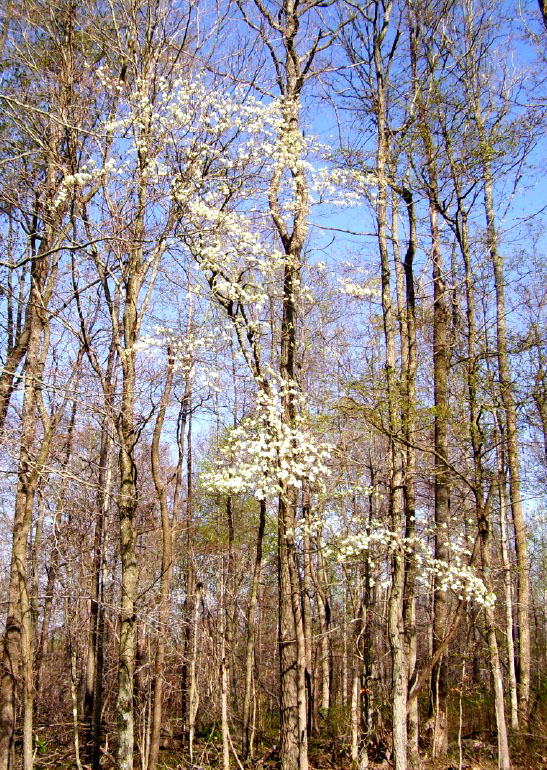
white-flowering-dogwood


Alene sends pictures almost every other week – her photos are not what mine would be, but I’m so fortunate to have her there to be my eyes, I won’t apologize for poor resolution or lack of composition; these pictures are precious to me, my only glimpse of all that I love and long for from half a world away.

The dogwoods have started  flowering now and soon will be a riot of white against the pale new green leaves of the overstory trees behind them.  One day not too far from now, I’ll be there to see their transformation for myself; until then, these ordinary photos keep my heart and mind tuned to a certain hilltop farm in south-central Kentucky, where the sun rises on bright spring-green pastures and sets on hardwood forests tinged with spring white.


trees-greening

 It has been a wet Spring thus far, with more than 4″ of rainfall by mid-April; 15″ or so for the year to date.  The forest will be exploding soon with life and the pastures are already at grazing stage, 8 – 10″ of tender, succulent young grass and clover.  Too bad I do not have any hungry sheep or cows to begin rotating through them yet…  It would be a good time for lambing, calving and foaling, with lots to eat and rains bringing more growth every day.

Spring Pastures

spring-pastures

How I wish I were back at the Farm right now.  Just look at the grass starting to green up, the trees yet to push leaves, still waiting for the days to lengthen enough to be safe from sudden frost.  Someday soon, I’ll live each day of each season there, noting the subtle changes in every living thing as the planet hurtles back around its yearly orbit, tilting the Northern hemisphere once again toward the burning star that makes all this wonderful stuff happen.

I have 30 days left over here in this East African desert; 44 days to being boots on ground right there (points to photo), in the middle of that very pasture, surrounded by the green grass and budding trees that wait patiently for me.  Oh, my farm is my lover, my waiting woman, beckoning me home with graceful arms and bountiful curves, life springing from her soils and grasses and forests and creeks.  How I yearn for her presence, her sounds, her smells, her touch.

This trip I will rescue the corral from certain death by weathering.  It was assembled perhaps 8 years ago, used only once, and put up too close to the Big Pond.  The panels are rusting and in dire need of a new coat of paint; I’ll attend to that then tear the whole thing down and stack ’em in the trees under a tarp, until I’m ready to set it back up again in a better location.  We’ll be there 10 days, so I’ll have time to sand and paint 20 8-foot steel panels.  I hope.

We’ll see if I can get Derril to take some pictures this time, to help illustrate the project story.  Bobby and Alene are thinking of taking a trip to see their kids while we’re there, since our stay is so long; it will be nice to have the Farm to ourselves for a change, and be able to power through the work without keeping a meal schedule or just being dang rude for not coming down off the hill until dark.  I’m bad about that.

Woman at Work

lady-horseloggerHere is Mel at work, skidding logs in late March at this year’s Open Woods Day in Floyd, Virginia.

She and Adam are apprenticing with the Healing Harvest Forest Foundation to become Biological Woodsmen.  They’ll head back up north to their farm soon, to start operating their own restorative forestry business  there, and will train, work, breed and care for my mares for a little over two years, until I can get boots on ground at the Farm in Kentucky.

It is my hope that the contribution of living capital, both the horses to use and the foals they’ll keep, will help them get a good start.

Mel’s a quiet girl, but intense and passionate too.   Were you to meet her on a busy city street, you wouldn’t guess she works in the woods with horses and chainsaws and huge, heavy logs.  Having done a myriad of non-traditional jobs my whole life, I can really appreciate another woman who fearlessly chooses to follow her heart into the woods and the fields and do work like this.  It isn’t just for men, and it’s a lot of fun, and we can be very good at it.

These two young people are very special, and very important, to their community and to the world at large.  Not afraid to roll up their sleeves and learn a complex craft that defies the conventional mindset of profit over every other thing, and that gives back to the Earth and her future generations.  They give me hope and remind me that good, honest dreams built of hard work are still all some folks need to be happy in this life.   Makes me feel good, that.

Horselogging School

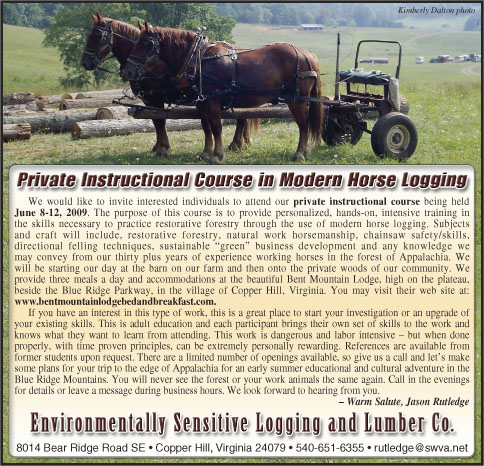
modernhorseloggingcoursead

The dates of this course of instruction fall nicely into the leave period I’ll have after I return home from this Africa deployment.  We’ll make a 10-day working visit to the Farm at the end of May, then I’ll put Derril on a plane back to San Diego and head on over to Virginia for some much-needed training for li’l ole’ Thistledog.  Horses aren’t the only ones that need schooling.

I’m really looking forward to this.  Been getting myself ready physically, too – years ago I could have jumped right out there from a dead stop; nowadays my stamina and strength don’t stick around without being called upon, and I haven’t done much physical labor lately.  So I’m back to weight training and hill-walking to bring myself up to speed.  It’ll pay off for the whole trip, as my project list at the Farm will have me up at dawn and working until daylight fades; got culverts to clean out, road ditches to re-grade, and the corral fence panels to re-paint and move.  Getting strong and tough now will save me a lot of pain later.

One thing I won’t be surprised by is the heat.  After a year in East Africa, my yardstick for comparing hot temperatures is mighty damned long.