Feeds:
Posts
Comments

Becoming a Workhorse

js-first-working-steps

  It takes a lot of time, effort and patience to train two big, beautiful, spoiled hay-eating machines to be actual workhorses.  There is nothing in either of my mares’ life experiences that prepared them for life on a working farm, being around other horses, noises and distractions, or doing anything other than lounging together in a big pasture and having grain and hay brought to them in abundance without any exchange of effort for it.

The transformation is being accomplished slowly, sometimes in small steps, sometimes in leaps and bounds – but it is happening.  This picture of 8-year-old Justice in harness, dragging fresh-plowed garden soil with a smiling Mel on the lines and Jason grinning as he removes the lead for the horse to take her first working steps, shows the progress they’re making and how pleased they are with it.  It choked me up a little when I first saw it, seeing the joy on their faces as they turned to show me through the camera how far they’ve come with the project of making these fine mares into workhorses for Mel and Adam to use.

I can see that horse’s mind working, too, which is the part of all this that I am the most in awe of.  This big, young mare has never done anything like this in her life – suited up in harness, responding to signals on the reins and bit and commands from the two-legged alpha, doing what she’s asked to do – this is as alien to her as walking upright would be, yet at the same time, it isn’t strange at all, and you can see her becoming, right before our eyes, a workhorse.  Two months ago she was skittery and lacking manners and herd-bound to her daughter; now she is much less all that, much closer to the skilled, experienced workhorse she will be in the years to come.  And it is happening because she’s figuring it out, and has good coaches, people who know her potential and know what is required to get her there.

There’s still much to be done and a long way to go.  Jason wrote yesterday that he’d bought a new sulky plow and is planning to hitch the girls between the two geldings they are pastured next to and have grown accustomed to, so they can learn to work by their example, alongside horses that know to move when asked and stop when told and stay still in between.  That should be a mind-opening experience for both of them.

A Little Snow

little-house-with-snow


The Blizzard of ’09 missed south-central Kentucky, as near as we can tell from Alene’s reports and pictures.  They got a two-inch dusting at the farm, just enough to look like winter for awhile, then the sun came out and it was gone the next day.

I am not unhappy that this area doesn’t get regular deep snows – one of the deciding factors for choosing this place in Taylor County, Kentucky, was the moderate highs and lows throughout the year; both Derril and I spent childhoods in long-winter states (he in Ohio, I in Colorado) and remember well the cold and endless months under snowpack, waiting for Spring to arrive.  So finding a place to live the rest of our lives with definite seasons (San Diego has nothing of the sort) but without a preponderance of winter was an agreed upon objective, ruling out many alluring properties that presented themselves in Idaho, Wyoming, and upstate New York.

We’ll have to treasure every little snowfall we get once we’re there.  And I’ll never have a sleigh; one horse-drawn vehicle less to fill the equipment shed.  I’ll have to put sleigh bells on the horses’ harness anyway during the winter, though, just to enjoy the seasonal effect.  And take lots of pictures when a storm of white comes through, to savor the beauty before it disappears.

Cutting Hickory

cutting-hickory-trees


Before we left the farm for Virginia on our last visit, we took Bobby up to the pasture edge to mark a couple of hickory trees to cut for firewood.  He’d talked about wanting some hickory firewood the entire time we were there, and although there are many trees already blown down that would make perfectly good firewood, by gum it was hickory the old man wanted.  Said his daddy burned hickory and it was the best firewood ever.  Needed a couple of years to season, so he wanted to get some cut right away.  Even though we haven’t put a stove in the little house yet, and they only use the fireplace if ever the power goes out.  And he has a stack of oak all put by.  Still, he wanted to cut some hickory, and I like to keep him happy, so I said I was sure there were a couple that could be culled for such a purpose.

Rather than leave him to decide which trees to cut, I said we’d go mark a few for him.  He couldn’t understand why I cared about hickory trees, said they weren’t valuable as lumber, no one would buy them.  To which I replied, I have no intention of selling any of my trees for lumber; I’m building a barn and a house with them, thank you very much, and a good saw log is a good saw log, whether it’s hickory or oak or poplar or maple.

So we drove on up and started around the pasture edge, and I asked him to point out any hickories he saw.  Bobby knows his trees, that’s for sure.  Can tell them apart by the bark, at a distance even.  We came up alongside three trees growing close together right at the pasture edge, which he said were all hickory but the one in the middle was a shagbark.  Well shagbarks are good nut trees, one of the best, and this one was growing straight up and had about 14-inch diameter already, but the other two were right next to it and sharing water, sunlight and nutrients.  Cutting them would leave the good grower to prosper by itself.  So we marked the ones on either side, and I said they’d give him more firewood than he would know what to do with, and vetoed his suggestion to cut the huge leaning hickory at the corner of the field, pointing out the three good saw logs in its lower trunk that may someday take their place in the bents of my big barn.

A week later they had a couple of days of good weather, and Alene emailed me that he’d got them felled and was busy cutting them into stove-length logs.  He dropped the first one right into the pasture, but the second one he felled into the woods behind; I would not have, I would have directed it out to the pasture as well, it was only leaning a little.  No telling what good saplings were crushed as it fell, but it was only one tree and he drug it out with the tractor by its butt onto the pasture, so minimum damage was done.

I don’t like that he doesn’t wear any safety equipment when he operates his saw.  He’s a careful old man, and seems to know his limits, but he does things the old way, especially if there’s much money or trouble involved.  You won’t catch me running a saw without chaps and a helmet with a faceguard and ear muffs, and I could buy all that for him but I doubt he’d wear it.  He cuts up quite a few trees and branches that fall across the paths and into the fields, so it isn’t like he wouldn’t get some use out it, but he’s a stubborn and tough old country boy.  Reminds me a lot of a hickory tree.

Schoolwork

adam-and-j

  The horses have been at Jason’s for a month and a half now; not all of that time in training, of course – work schedules and weather take precedence as they should – but they’ve been getting schooled in all the basics and have really come a long way.  Mel and Adam have handled them nearly every day and worked with Jason on all the lessons so this is a real team effort.  I am glad we were able to get the horses to them well before they were finished with their Biological Woodsmen apprenticeship, so they are part of the girls’ training right from the start.  It will make for a very strong bond between the young horses and handlers, I think.

The weather was cold and nasty as January finished out, so they spent time in the barn, introducing them to bits in their mouths and simply handling them a lot on the ground including mane and forelock thinning.  They discovered J didn’t like being touched on her poll or top of the head, and would fret and shake her head, so that had to be worked through.  Adam is very tall (he makes her look small in the photo above but she’s really a brute) and exceptionally patient, which helped a great deal. 

Next they sacked them out with an old bridle, and put the harness on them.  More bit familiarity, learning to be comfortable with it in their mouths, eat around it, and yield to pressure as a signal.   Jason wrote, “They are getting better manners every day, and we will keep up their handling toward the end of them being productive working animals.”  I’d remarked they were like kindergarten students, to which Jason replied they were more at an elementary school level – such good news to hear. 

Hooves were trimmed the next week, and the horses did very well – all the daily handling had paid off.  On February 5th Jason wrote, “I think they did very well with the foot work.  Having good control on their head and teaching them about standing still, respecting our space and being rewarded for submitting to our handling of their feet is important.  They are tractable.  We will make great horses out of them.”  

They are spending time in separate box stalls during the day, which is making them braver and less attached to each other as a herd, and better animals all around.  School is going well.

A Touch of Ice

tree-ice-and-shed


 Last Tuesday’s ice storm through Kentucky and surrounding areas hit the Farm, but not as bad as it could have.  The folks were without power for an hour and a half, they said, and had to burn quite a stack of wood in the little fireplace to keep the place warm.

It’s an all-electric double-wide trailer house, on a permanent foundation, with good 6″ walls well-insulated, but you know, with electric heat and an electric stove, you’re just screwed when (not if) the power goes out.

We’re planning on installing a little wood-burning stove where the fireplace is – probably do that next Fall.  By the time I move there, I’m going to be heating with wood, and might even get a propane stove put in, too.

But the folks are ok and the temperatures are climbing again, so for now, disaster has been foiled.  A friend up in the Louisville area wrote about this ice storm up there, and spoke of one a couple of years back, down in Arkansas where they used to live, that snapped big beautiful trees with the sounds of gunshots.   I do not like to see great living things damaged like that, but if they do go crashing down, you just make more firewood, I suppose.  And any good saw logs can be made into lumber, if you have the means to do that.

Stories and Lessons

ls-first-lesson_jason-and-student


We arrived at the girls’ new home in southwest Virginia around 3 pm – a little later than planned for, as the 7+ hour drive from Kentucky turned into more like 8 with a few wrong turns and all the winding roads to navigate through.  We’ll surely plot a more straightforward route for next trip, but it was scenic and took us through some beautiful country we’d never seen before.

After hello’s and introductions, Jason took us straight out to the barn where J and L were waiting in box stalls, getting brushed by Melanie.  She led them out one at a time, to stand there in the corridor near the open door, for me to have a look.  Oh, what horses these are.  Tall and thick, with legs like oak trees and densely muscled haunches and shoulders – they’ll be pullers for sure, once trained and used to it.  For now they are very good at one thing:  eating hay, and have not learned to stand still, and are maddeningly attached to each other, as you would expect a pair of horses kept together and not worked to be.

I had asked if we could see them move in the round pen, and the late afternoon was not too cold, so we took them up js-first-lesson_girl-in-motionthere one at a time, to see their response to Jason’s gentle requests, loose in the corral with him.  They started out distracted, but moved out well when asked, and connected with him in just a few minutes – a good first lesson, I think.

We led them back down to the pasture in front of the house, and went in to the warmth for a wonderful evening of  conversation, endless stories, and delicious home-cooked food.  I was sorry we only had the one afternoon to spend there.  But it was good to meet everyone, and see the horses, and know they are in good hands.

Winter Upkeep

 snowy-road-through-woods-copy 


It snowed our first day at the farm – big, fluffy flakes drifting down lazily, unhurried, barely covering the ground.  A pretty sight indeed.  Temperatures hovered near 20 dF both days, but we’d brought lots of layers and hats and gloves, expecting that. 

It was a good working visit, if a little short and cold, but we got all the upkeep and repairs done that we came to do.  Well, almost all…the topmost culvert on the road had filled in but the fill was too frozen to dig out, so that’ll have to wait until the next visit.  But I got all the leaves cleaned out of the upper road ditch, something that needs done every year to keep the drainage working properly, otherwise the water starts to travel downhill out in the road away from the ditch and makes gullies. 

The year before last – 2007 that is – the road was so badly washed out that Bobby had to “fix” it after every rain, but he was just scraping loose fill into the gullies and not really dealing with the underlying problem of the culverts not doing their job and the road grade not working to ditch-cleaning-with-dog-copychannel the water to the side.  So last spring we spent four days digging out all the culverts and grading the steep upper section of road, re-establishing the grade into the side of the hill so the water didn’t take the straight line down the middle.    It held up pretty well, I must say, and he only had to run the box scraper over it once this past year.  The culvert mouths were filling back in, which I expected, but the grade was still intact and it looked like the water was travelling in the ditch like it should.

Raking leaves up on the hill with the light snow falling, listening to the birds call through the forest and squirrels rustling in the leaves as they dashed from tree to tree, I felt deeply contented.  It was slow going in the cold and a long stretch of road, but I was happy to be on my farm, tending to necessary work.  I paused every now and then to walk among the trees, making mental notes about how much to thin and which trees would need removed first.  There’s lots of post and pole material for fences there, as well as some good saw logs out of the bottom of damaged, crooked and crowded trees.  Lots of forest work to do here. 

Wednesday afternoon I spent up on the ladder cleaning the leaves and ice out of the shop gutters, while Derril fixed the big security light on the front of the shop.  Good to get all that done, as Bobby’s knee surgery and arthritis make ladder work quite difficult for him.   He really has no business being up on ladders these days.

The folks are looking at a little house on 5 acres down the road near the Elk Horn turn off; they like this area and don’t want to leave the doctors they’ve established care with.  Their grown children are in Florida and Oklahoma but they don’t want to live in either place.  Alene said they were a little concerned about not having family close by and I assured her we would always take care of them – said they were like folks to us, and she replied we were just like their own children to them.  I can see they’ll always have an attachment to the farm, but would be happy to live close by on a smaller place.  I hope it works out that way.

We left for Virginia to see Jason and the horses early Thursday morning, in the pre-dawn darkness before the folks were even up.  The stars were shining brightly.

The Pond Windmill

bigpondsunset2


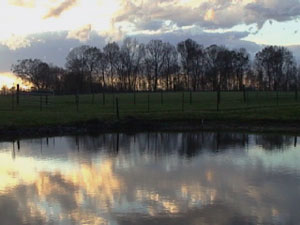
Just updated the Farm Projects page with a summary story of our visit in April ’07 to install an aeration windmill on the Big Pond.  It isn’t the most in-depth story, but I failed to blog about it at the time or write anything down shortly afterward, so I’ve only got two-year-old memories to go on, along with some pictures captured from the video I took while we were there.  My handycam batteries ran low just as we were getting ready to drive the blade section up the hill and put it on the tower;, which was too bad; that would have been a wonderful documentary of the really exciting part of the project.

Next story will better documented from a previous blog post, our pasture renovation project the following August.  I’ll work on that this week and try to get it up before I fly home.

Four days left to scramble all the loose ends together here at Camp Lemonier, get my weekly reports and tasks assigned to helpful folks who can keep them running while I’m gone, and then the long flight home.  We’ll fly to Kentucky during the second week I’m back, to visit and work at the Farm, then a half-day’s drive to Virginia to meet my girls, and Jason and the crew.  I’m beside myself with anticipation.

Finding the Farm

pastureentrance


In the stilled place that once was a road going down

from the town to the river, and where the lives of marriages grew

a house, cistern and barn, flowers, the tilted stone of borders,

and the deeds of their lives ran to neglect, and honeysuckle

and then the fire overgrew it all, I walk heavy

with seed, spreading on the cleared hill the beginnings of green, clover and grass to be pasture.  Between

history’s death upon the place and the trees that would have come

I claim, and act, and am mingled in the fate of the world.


“Sowing” by Wendell Berry


Going through some old posts the other day I stumbled upon my original farm-related entry, a first attempt at capturing the thrill of possession just weeks after we had closed the deal, as I was steaming across the Pacific Ocean on the first leg of a 6-month deployment.  Still in shock that we’d actually made it all happen.  Savoring the feeling of groundedness and promise amidst the clamor and bustle of life on a warship.  From March, 2006:


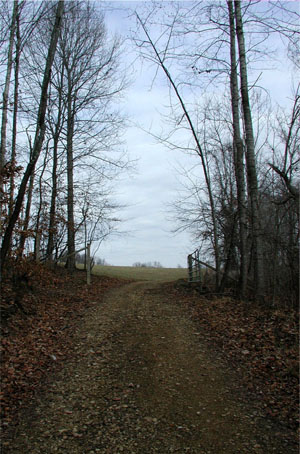
This is the last few feet of the road up to the pastures – the heart of the farm. You can see the grassy hill swelling up past the trees, past the gate, and the distant treetops peeking over, marking the far edge of this central pasture.


Even now as I look at this photo, I can remember standing there, bundled up in the 30-degree cold, feeling the forest surround me, the quiet winter-hushed Kentucky hills stretching away on all sides, neighbor’s farms well hidden in the adjoining hollows, and thinking how very wonderful it would be to own this. To become related to this place, to follow my dreams, to work as hard as I want, to live my days out here.


That morning it was just a shimmering, tantalizing possibility. I had traveled back to this beautiful area with two good possibilities picked out from my exhaustive Internet search, to find my farm. I knew this with my whole heart.


And though my husband does not exactly share my passion for the life of a farmer, neither does he discourage it in me. In fact I’d say he respects it very much. He knew why I went there. He knew I would find my farm. And he had already decided once I’d made my choice, we would take action.


I didn’t know that yet, that morning. I was just acting on this impulse that has powered me since childhood, and trusting that it wasn’t going to fling me over a cliff and break my heart. Trusting this identity that I am both once again, and finally, stepping into like a pair of well-worn jeans. I am and have always been a farmer. Just never had a farm.


And so I walked up this road, and walked the pasture edges of this farm with my camera in hand, the cold January wind numbing my hands and my face out in the open of the pastures. I stepped into the woods, warmed suddenly by the lack of wind, and felt the hush of the bare trees, the forest floor thickly carpeted with fallen leaves, the thin grey winter sun streaming through the branches. I walked for three hours, from one end of it to another. I turned and squinted and tried to estimate how large the pastures were, and I stopped in several spots to imagine a house here, or there – was the sun the right direction? Would it be protected from the wind?


Then I went back down the hill, and sat and talked with Bobby and Alene for another two hours. They took a liking to me, I could tell that right away. They liked that I was in the Navy, and I felt they were proud of that. I told them why I wanted a farm, why it was important to me, and we talked about cattle and sheep and chickens and the tobacco Bobby’s family had raised there when he was a kid. He was born and raised on this farm.


I told them I would have to wait 6 years before I could retire and come live there. They spoke about their children and grandchildren in Oklahoma, and their other family in Florida, and made it clear they hadn’t really decided which direction they would move, if at all. They liked living in Kentucky just fine, they said. I told them it would work well if they wanted to stay for a time, to take care of the place. We talked pleasantly, not making any promises, since I was just there looking, like other people had been, and didn’t know if I would be able to make an offer.


We talked slowly, and quietly. We talked about the war, a little, and about the economy, and about farming. They showed me the rooms of the house, and I went out with Bobby to look at the shop, and the tractor. I complemented him many times on how well he had taken care of the pastures, and how solid and well-built the fences and gates were. He was pleased to hear that, I could tell. This old man, stout as a barrel, hard of hearing, labored of breath – this man cared for this property as though it were his childhood home, because it was. And I recognized that, and thanked him for his efforts, and I could tell, the deal would be made.


And it seemed to make no difference whatsoever to him that I was a girl.


I may tell the rest of the whole story at a later date. But now I owe answers to your questions, or I will never be able to catch up.


Some of you want to know, “What type of farm is this? Dairy, agricultural … or horses?”


Well right now, it’s a low-maintenance pastured livestock farm; Bobby only runs about 25 head of Angus feeder steers on it each summer and has a neighbor cut hay once or twice. There are dairy farms in the area, but dairying is a labor intensive and complex operation, even on a small scale.


In a nutshell, my farming will be small-scale, diversified, and follow sustainable organic principles. Bearing in mind I won’t have to pay a mortgage or feed six hungry children with the profits (nor will I have their help with chores!), I will probably start with a small herd of grass-fed beef, a small flock of sheep, perhaps a small milk cow or goat, a few chickens, a few laying ducks, raise a hog for the freezer, and of course grow fruits and vegetables. The main intent will be to feed ourselves and make enough profit on the excess to pay for supplies, vet visits, and such.  Those of you who know me won’t think that sounds like too much work at all. 


One of the first things I’ll do once I get there will be to buy my team of Suffolk Punch horses, some basic horse-drawn implements, and learn to work them. This could take several years. (That should spawn a whole rash of questions which I am perfectly willing to answer – please ask!) I should be able to eventually raise an acre or two of corn, and oats, and other livestock feeds, and I will practice rotational grazing by subdividing the pastures into several-acre paddocks, and move the cattle and sheep and horses and chickens between them to maximize the forage health. I will improve my pastures by spreading manure and minerals, overseeding, and managing the grazing levels. The ponds will be stocked with fish, providing yet another source of meat.


The double-wide trailer home will be an excellent transition residence while the timberframe-and-log house is being built up on top. I will want a barn and perhaps some outbuildings built up there as well, so I’ll need to be there on scene to oversee the work and perhaps do a portion of it myself. We anticipate that D will remain in San Diego at his job as long as possible, and I will move to The Farm a few years earlier, once I retire to get things started. The sale of the house in San Diego will cover the construction of the buildings and any startup costs I’ll have such as livestock and farm implements.


Once The Farm is up and running, my retirement check should cover operating expenses, and in a few years the critters should about pay for themselves…


And so the dream began, three years ago.  I am still awestruck at my good fortune in finding this property, having the leverage from our San Diego home to pay for it by refinancing the mortgage (surely couldn’t do that now!), having the support and complicity of my life partner as I leapt off the cliff in pursuit of my life-long dream, and most importantly, in having been blessed with this lovely old country couple who were content to remain in place after selling it to us, and take care of it until I can get there.


God has surely smiled down on little Thistledog.  And now the Suffolks are a reality, thanks to good people who were willing to help with a plan to give me a head start with them.  Lordy, I surely could not be more blessed.

Delivered, finally

lariahandjustice3 


 Yesterday afternoon the seller emailed to tell me the horses were on their way.  They left late Tuesday, and he said they looked so good, those two big horse butts in the trailer with their pretty new (warm) blankets on, ready for the ride.  He expected them to get to Virginia Wednesday afternoon, which they did.  Jason emailed yesterday to say they made it; they were good big mares for sure, and the filly was silly but not mean or bitchy like the one he’d had to contend with the first time this woman tried to haul, when she brought just her own two down and left mine waiting in Michigan.

So he just posted a quick note to tell me they were there, and said he’d write more later and outline his proposal for this project.  I am delighted to know the transfer from Michigan to Virginia has finally happened, the horses are safe, and they’ve made a good impression on Jason, who will be training them to harness and work. 

The “project” is just that – these horses were imprinted at birth but handled very little since then — they were up for sale as having “potential” for working in harness, which they have, based on their bloodlines, all good working animals there — but they’ve had absolutely no acceptance training, no fundamentals at all yet, so they’ve a ways to go.  We weren’t looking for green horses, we were looking for a team already started, that could jump right into the logging jobs he and the apprentices are working this winter… but I moved too fast on this deal, and so the original plan is more complex, will take longer and cost more,  for my haste. 

We’d already agreed we wanted these mares for their breeding potential,  though, and when their lack of training came up I bridged the sticking point by making clear to Jason he would be paid well for the service, if he had the extra time and inclination to take the project on.  I’m not looking for “something for nothing” here, I understand the task involved and since I’m not there to do it myself, and he’s been training horses for many years (and I’ve seen his horses in action; the results are fabulous), I can’t pass up the chance to get my horses started right, no matter what the cost.

I’ll tell you this much:  run the tape ahead three years, to the day I haul them home to Kentucky myself, and begin my own round pen work and basic driving exercises with them – me, a beginning teamster, with work to get done so not a lot of time to start from scratch and patiently progress both myself and a beginner team to significant working capacity.  Instead, I’ll bring home a team of horses that have been started well by a Master with the best training for their working purpose I could possible hope to give them, and who’ve had several years of working in the fields and woods under the tutelage of good horsepeople trained by the same individual… that’s a hell of a deal, just what I’m looking for, and will be worth every dollar spent.

It’s a new year, folks, and this is a great start to it.