Feeds:
Posts
Comments

Pond Nazi

pond nazi fences free rangers

You were expecting a picture of a pond, perhaps.  Yes, we have a pond – in fact, we have two up on the pastures.  And we have ducks; thirteen now, soon to be a smaller number; Muscovies, as you might be able to tell by the prominent red caruncles around their eyes in the photo above.

You would think that ducks and ponds go together.  In fact, they do, but to a fault.  The fault is, once the ducks make it to the pond, that’s all they ever want to do; that’s the only place they ever want to be.  They camp on the pond.  It’s ducky pond camp.  They trample and poop around the edge, and swim off into the middle whenever I approach.  They won’t get out of the pond and go back to their hooch in the evening.  The pond, for the ducks, is Nirvana.

But it’s not where I want them to be.  Paddling around the little pond all day and sleeping on it unprotected from predators, is not what I’m paying them to do.  They’re tree ducks, actually, and their owner’s manual specifically states that they do not need a pond to live well and prosper.  They have plastic concrete mixing tubs for bathing and cleaning out their little duck nostrils, which I keep clean and filled twice daily.  They have a nice big hooch with lots of bedding to snuggle into and locked doors at night.  They have cow paddocks to forage bugs and fly larvae in.  They have an always-full feeder of delicious high-protein crumbles.  They don’t need a damned pond.

But the ducks love the pond.  And once they found the pond, they wanted nothing else but to camp on the pond.  So I moved them and their hooch further away, down by the yearlings’ winter paddock, thinking the shift of territory would stymie them.  Oh, no.  The first day at that new location, the very first hour after they were let out in the morning, they hoofed it right back to the pond – a journey of perhaps an eighth of a mile, I might add.   They are pond addicts.

But the pond is mine, and I hired them for pasture duty.  And getting them de-ponded is not an easy task, unless they are very hungry and can be lured off the water with a shaken feed can.  My alternative methods of getting them out of the water ranged from shouting, banging sticks, throwing sticks, chucking stones at them (to scare them out, not to hit them), and attempting to send a dog in after them (to herd them out, not to eat them).  The one night we went up to put them to bed and found them back in Nirvana Pond, the dogs and I had to admit defeat and leave them there all night, after much thrashing about in the dark on the overgrown pond edges.  Sitting ducks, as the phrase goes, and it was just luck they were all still there in their little flotilla in the morning.  The countryside is full of hungry dogs, foxes, and racoons.

So, like the Soup Nazi in the Seinfield episode, I furrowed my brows and in my meanest voice said “NO POND FOR YOU!!!”

Poultry netting got put back up yesterday.  Half the flock figured out how to worm under the bottom of it and spent the whole day back in pond camp, where they got hungry enough to come out of the water when I shook the feed can at them in the afternoon.  So this morning I snugged it all down before I let them out of their hooch, and that did the trick.  Time to start relocating the big boys to the big freezer, though.  I am hopeful that once their numbers are smaller, once the flock is only hens and a couple of drakes, their wanderlust will subside and I can let them free range around their hooch again.  Otherwise, we’ll have to come up with a way of plunking their pen down in the paddocks so they can do what they’ve been hired to do:  catch flies, not fish.

No stranger to winter

Splitting hickory

My farm is in Kentucky, but I’m a Colorado native.  A lifetime ago, when I was in my early twenties, I lived and worked year-round in the northern foothills of the Colorado Front Range,  where the snow that comes in October doesn’t stay until April, but the cold sets in for the season and can be serious.  I cooked on a wood cookstove back then, so firewood was a way of life, all twelve months of the year.  In winter it became even more important, as it also provided our only heat.

I’m no stranger to the task of laying up a supply of firewood for winter.  Felling whole trees, cutting them to stove length, and splitting the logs into burnable chunks – these are familiar skills, though I’ve not used them for many years.  (We bought a cord of split firewood every winter in San Diego for the fireplace, but the only work of that was loading and unloading and stacking.)  So I’m pleased to report, I can still swing a splitting maul well enough to reduce a whole log into halves, then quarters, and so on.  A very necessary skill here.

There is really nothing quite like the satisfaction of driving a splitting maul into the top of a 14″ log and splitting it in half in one clean stroke.  Starting a clean split, as in the photo above, that can be finished with a sledge hammer pounding the splitting maul through, ranks a close second.  It takes a certain amount of force and technique, there’s no doubt.  One has to swing the maul with every intent of cleaving the log; head speed is critical.  And aim is even more so.  But when the two collide with wood grain ready to break apart, it’s a beautiful thing.

There are easier ways to split firewood.  I can borrow a wood splitter from friends and probably will, soon.  But it is good to know I still have the skill and strength to turn a tree into firewood, by hand, in a couple of afternoons with the right tools.

This first winter at the farm is my first real winter in 25 years, and I am late in all my preparations.  I’d rather not be splitting firewood in December for this year’s fires.  Glad, though, that I’m able to.

Wrench monkeys

We stacked up quite a list of equipment maintenance jobs to do during Bear’s visit here.  Of course the list was way too long and optimistic for the time available, which was three weeks; in addition, he caught a cold on the flight over and so his first week was a no-go for anything other than sneezing, coughing, blowing his nose, and drinking lots of fluids, inside the warm house of course.

But together we’ve gotten a lot accomplished as these three weeks draw to a close, which is a great relief to me, for although I’m pretty capable of doing a fair share of wrench monkeying, my days are stretched rather thin with lots of other requirements.  So all the vehicles and equipment have had their oil changed, the big truck now has mud flaps (Merry Christmas to Thistledog from Bear!) and Jack the Tractor is in the process of getting new gauges and lights installed and wired up.

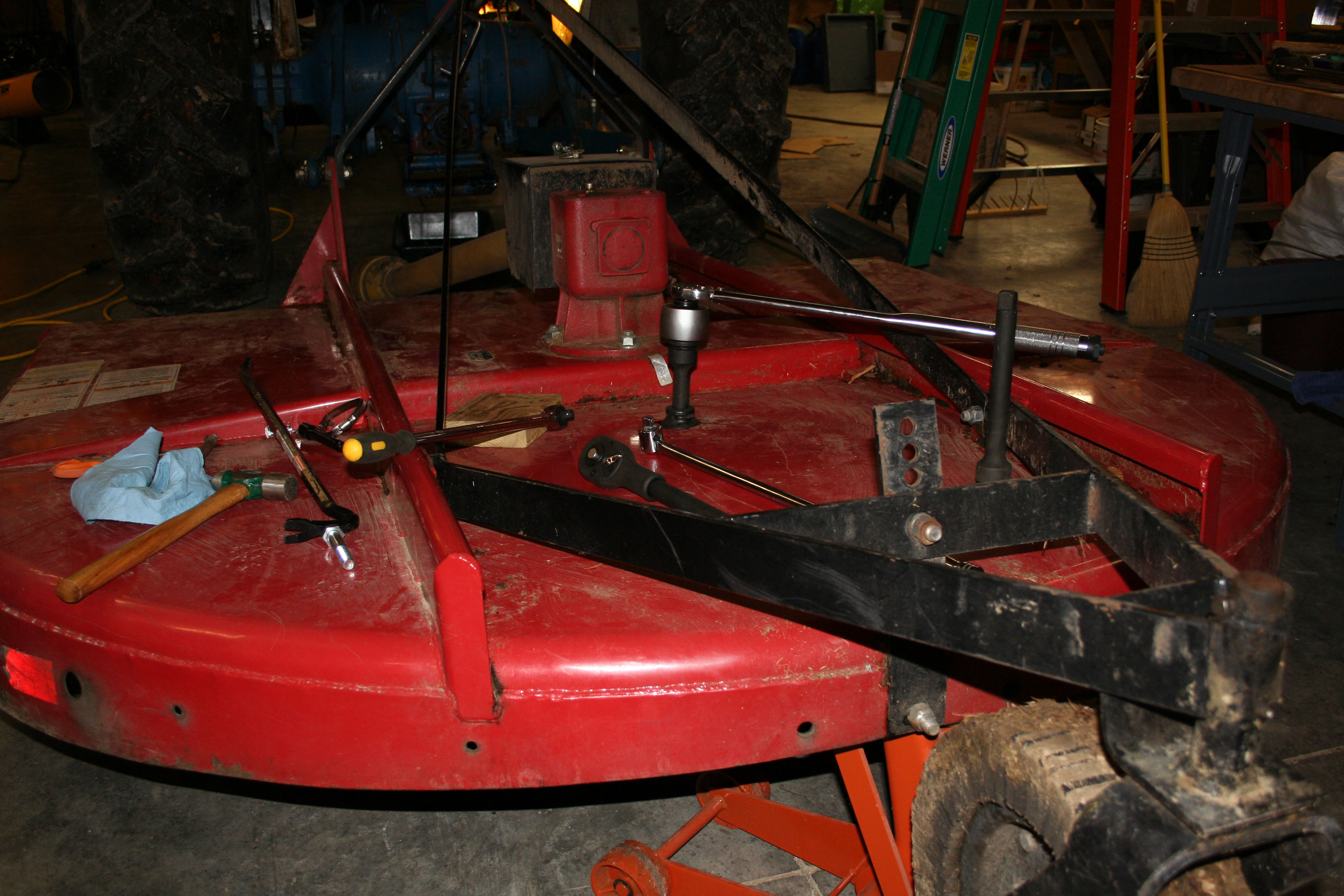
Yesterday we changed the blades on the Bush Hog, which isn’t a one-person task by any stretch of the imagination.  It was a little more difficult than it had to be, owing to the ginormous socket getting stuck on the nuts after torquing them to 600 ft/lbs.  I think we used the wrong size socket but you know, it turned out ok anyway and we needed the gear puller I had to go into town and buy to pull it off, so I’m not arguing.  New blades will make clipping and mowing pastures so much easier on the tractor, and the tractor operator, too.

More hay laid in

Sunday I finished hauling in another 30 round hay bales for the cows’ winter feeding.  This hay was made just down the road by a guy that’s been making hay a long time and doesn’t have cows to feed anymore.  It’s really good hay, despite having been left out in the weather until now.  Even the spring hay is in good shape, and the girls are loving it.  I’ll be back for more, I think, to make sure we have plenty well into April, so I don’t have to start grazing too soon.

I hustled up to the pasture yesterday morning to get it covered before the predicted rain hit, and finished just as the first sprinkles started.  It didn’t rain much, but I wanted it covered before it did.  This next spring and summer I’ll buy it from him early and haul it out of the field right after he gets it baled, put it up on logs to keep it off the ground, and cover it before it ever gets any rain on it at all.  Lots of hay goes to waste by leaving it out in the rain, although it’s pretty common around here; you see a lot of hay lined up on pasture edges like this, without any cover.

A barn with hay storage will be nice, when we get to that point.  And as time goes on I’ll be able to manage the paddock rotations better and graze longer into the fall and winter, which will reduce the amount of hay needed.  Meanwhile, it’s about keeping the redheads fed and healthy.


At a bear’s pace

This coming Saturday, the first of December, I will have been retired from the Navy for a year.  A year, for heaven’s sake.

I’m amazed that an entire year has passed already.  Not that it flew by, not at all.  Most of it dragged on like a bad cold I couldn’t shake, testing my patience, challenging my well-laid plans, and taxing me both physically and mentally to my limits.

What a year it’s been.  Full of major changes, some of the hardest work I’ve ever done, more adventure than I ever could have imagined, and lots of unexpected twists and turns that have kept me busy figuring out how to do stuff I’ve never done before.

In addition to packing up 30 years of accumulated possessions, traveling cross-country with two dogs, setting up rudimentary housekeeping at the farm, and acquiring an entire cow herd, the heat and chiggers and physical exhaustion nearly kicked my butt.  And I’m still living amongst stacks of boxes, still looking for things I know I packed but haven’t found yet, and wishing I could wave a magic wand and have all the settling in stuff done now, please.  My heart aches for orderliness, balance, and efficiency.  My life doesn’t have much of any of those in it right now.

But I’m getting there, dammit.  At a bear’s pace, it seems:  lumbering, measured, deliberate.  Not speedy.  Not magic.  At times not seemingly making any progress at all, just meandering.  But the truth is, I continue to whittle down the daily lists of things that need done to care for livestock, pay the bills, keep the larder full and food on the table, prepare for winter.  I am getting my feet under me.  And I am rewarded with a small but growing level of orderliness, balance, and efficiency where just a few months ago, there was none.

Getting back to this blog, this narrative of my small farm journey,  is one of those deliberate, necessary steps toward where I need to be.  Yesterday I finally updated the Flickr pictures on the right of the page, replacing the shots of winter snow and ice from a visit two years ago, with photos taken the past few months.  Since late October I’ve been back to keeping a daily journal, and I’ve reserved time each day to write posts, taking my camera with me more often to capture the magic that happens every day here, magic and beauty I’ve lately been too overwhelmed to see or appreciate.

It’s the year mark.  Five months here at the farm.  Time to shake off the negativity, push through the brambles of doubt and lost confidence, and lumber into the sunny clearing ahead.  One bear paw in front of the other, I’m getting back on track.

Good food

Holidays give us a great excuse to spend a little extra time making good food. It doesn’t always work out that we have the time, and ocasionally the day is just another ordinary day, as it was for my friend Liz in San Diego, who shared a galley-cooked meal with a crew of Navy sailors onboard a dockside submarine.  But when circumstances permit a gathering of hungry friends or family or both, it is a splendid opportunity for culinary excess.

Our gathering here at Bear and Thistle Farm was small this year; just Bear and I, and the two dogs.  But I cooked my little heart out, we stuffed ourselves on wonderful good food, lolled about watching movies all day and laughing at the dogs’ antics, and generally enjoyed ourselves very, very much.

I am so thankful for the goodness and blessings in my life.

The duck roasted up beautifully.  After a great deal of internet research on how to cook a duck, I ended up using Julia’s instructions for roasting a large chicken, which starts it out at 450 degrees, turning from side to side, then finishes at 350, breast up.  Everything else was focused on getting the fat to drain from the bird, and these little ducks have virtually no fat under the skin at all.  Here it is, ready for the oven:

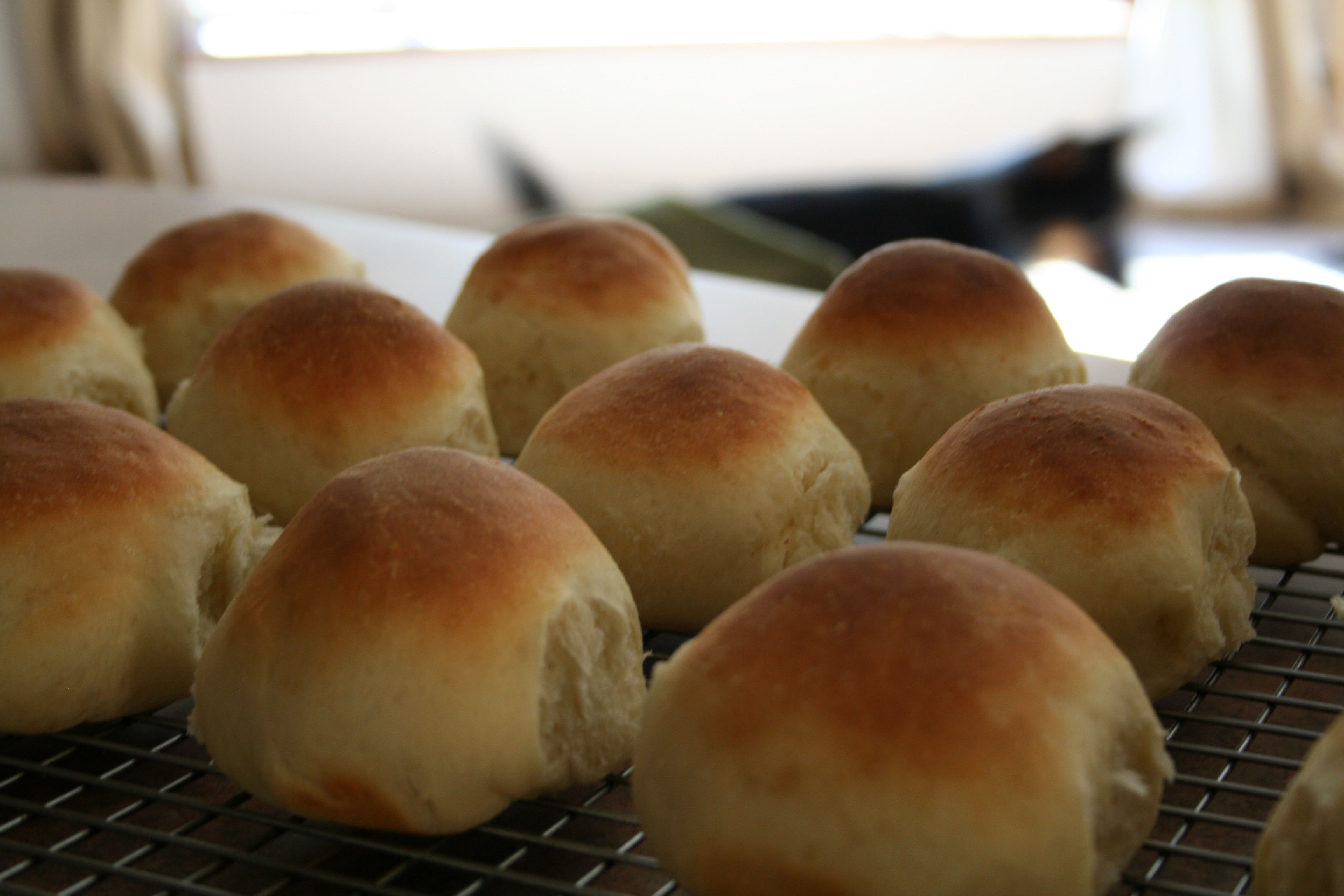
And despite my intention to take a picture of the roasted result, the carving knife got busy too quick and so we just dug in.  It was delicious; dark and succulent and very mild-flavored.  The gravy was spectacular, as well.  Paired with mashed potatoes, herb and onion stuffing, fresh beets from the garden, and Bear’s favorite 60-minute rolls, it was a splendid meal.

Two down

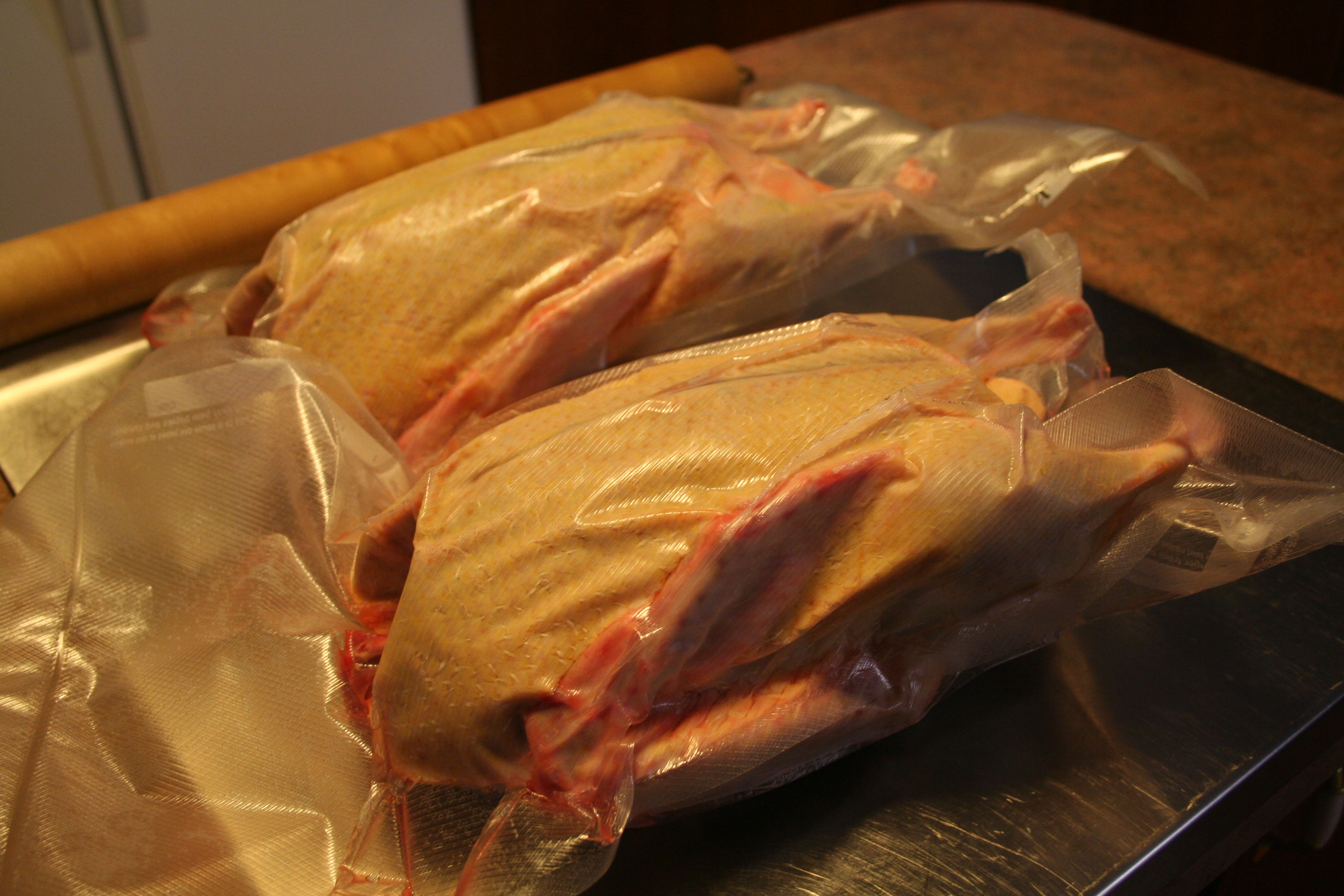
Duck butchering went well yesterday.  I picked the two white drakes out of the bunch while they were still inside their hooch, and trailered them down to the house in a wire dog crate where they hung out until early afternoon.  The weather was perfect – 63 degrees and sunny – so no cold fingers nor any flies.

We noted that the first bird plucked easier than the second; we think because we scalded it longer.  There wasn’t any problem with skin tearing, so next time I’ll probably swish a little longer in the hot water before cooling them in the ice water.

I’ll be getting a tool to help scrape out the cavity, too, as that was a little difficult with their long bodies.  The livers look wonderful, can’t wait to cook them up.  Both birds are “relaxing” in the fridge in their vacuum-sealed bags, the one to be roasted on Thursday and the other to start the freezer flock.  They dressed out right around 5 lbs each.  Perfect.

Thanksgiving duck

I brought home 15 eight-week-old Muscovy ducklings in mid-August, to start a bug-eating flock for the cow pastures.  Fly control, or one element of it, hopefully.

They are now 21 or 22 weeks old, nearly full grown.  There are only 5 little hens in the bunch.  I don’t need 10 drakes to 5 hens, that’s for sure; two will be plenty.  So the extra boys are destined for the freezer, and one will volunteer for Thanksgiving meal duties.

It’s been 30 years since I processed poultry, so I’m only going to do two this first go-round.  I won’t take pictures of all the steps, maybe just one before and after.  We’re assembling all the items needed and test-firing the scalding pot today.  I built a killing cone yesterday out of scrap sheet metal, using dimensions I found online.  Hopefully everything goes smoothly, although I’m not looking forward to the hand-plucking.

Bear is here on his first semi-annual visit, over the Thanksgiving holiday – so nice to have him here.  With any luck, we’ll have a succulent young roasted duck with our mashed potatoes, stuffing and gravy this year.  Bon apetit!

Farm dogs at last

I started this blog post a long time ago, when Skeet and Bandit and I arrived at the farm back in the beginning of July, and I had high hopes of settling into a routine that included regular updates.  It has been a lot like heading downhill on a black diamond ski run as a beginner since then, to be quite honest.

How could I have thought it would be otherwise?

At this point in the story telling, with the long, hot drive from California to Kentucky just a faded memory, 4 months and two seasons under our belts, cows up on the pastures eating hay and winter knocking at the door, I don’t think it’s possible to catch up on the details.  I’m not sure I can even write a decent synopsis of the events that have packed my days since arriving here on the 3rd of July.  No, I just need to get started back to posting, which will be a huge achievement in itself.

I’ll try to explain as I go.  It’ll be skippy for awhile, I’m sure, but eventually this narrative should smooth out, the missing pieces will get filled in, and it’ll start sounding more like the story of a woman starting up a small farm, instead of just dreaming about doing it.

Bear with me, please.  The adventure has just begun…

This post is long overdue.  I started a draft many weeks ago titled “Countdown to Kentucky,” but gave up on finishing it when I had to throw my countdown calendar out the window and resign myself to being here in suburbia much longer than I’d planned, when it became apparent the final projects were progressing more s-l-o-w-l-y than originally allowed for.  As usual, I underestimated the time and energy needed for several of the most complex, labor-intensive portions.  How does anyone know how long a certain job will take from start to finish?  All we can do is throw a dart on the wall and aim for it, which is what I did.  So I aimed too low.

I’m still counting down, but the target is softer now, made squishy with humility.  First it shifted four weeks to the right of my first departure date, and now another week or two is inevitable, if I want to get everything done.  And I do.  Though I would dearly love to be at the Farm already instead of here.

Truth is, aiming at leaving early (my original date was May 16th) has helped me accomplish an enormous amount of work in a ridiculously short period of time, much more than if I’d had a more “realistic” departure timeline.  I call this working better under pressure.  Scare yourself into thinking you only have a week to build a spaceship, and you will probably get at least the launch pad poured by Friday, all by yourself, which would be a monumental achievement by any measure.  This pretty well describes what I’ve been up to since March 26th, after my household goods were all packed in the trailer and taken away, leaving me free to concentrate on the landscaping projects.

My “Daily Notes and To-Do Lists” notebook charts the course of these final efforts, and it is truly amazing to look back through the days/weeks/months and see what I’ve gotten done.  It makes the list of work remaining look really, really small, which is such a good thing.

The moving trailer was picked up on Monday, March 26th; on March 28th two pallets of block and a yard of gravel for the last terrace wall were delivered, and I spent the day moving more than a half-ton of concrete by hand from the driveway to the edge of the backyard.  The Final Landscaping Projects phase had begun in earnest.

I’ve kept a rigorous schedule since then, fueled by my passion to get everything done and focused on the mid-May departure date.  My day – every day of the week – begins at 5 am with coffee-making and a shower, then out the door walking the dogs by 6:30, then back home to breakfast for the three of us.  I’m lacing on workboots and grabbing my gloves by 8 am, just as though I were working on my old landscape crew.  I knock off around 6:30 pm to take the dogs for their second walk of the day, then it’s shower and eat something and check email and update status on Facebook and finally drag myself to bed.  Blog posts take too long for me to write at this pace.  A simple sentence or two and a progress photo on my facebook page has been about all I can manage.  But it has paid off:  I am down to the last of it now, and the things completed outnumber the things left to do by a long shot.

I’m still not done yet, though.  As far along on the list of things as I am, I’m still here; the dogs and I are still here in San Diego, walking the chaparral canyons for exercise instead of hiking up the farm road or running through the lush pastures of the farm; making improvements to this little suburban home instead of setting up our livestock operation in Kentucky.  I dare not even plan the final trip, having already forfeited a non-refundable ticket for what I thought would be Bear’s return flight after helping me drive out there and unload, purchased when the best guess I could come up with was it would all be done by mid-May.

Ah, well.  This is life, this is but a small glitch in the Big Project, this is nothing, really, in the Big Scheme of Things.

In truth, it is a test of my strength, and fortitude, and determination.  I planned to do these renovation projects on the house and yard before I left and it is important to me to finish them and leave this little place in good condition when I go.  So I am in limbo here; working joyfully on hugely satisfying projects I’ve had to postpone for years and finally have the time to do, but aching to be gone, to be planted on the Farm, rising every morning with an even longer list of projects to throw myself into.

This strange and frustrating moment where I am stuck between my two lives will end soon.  I’ll survive project limbo, and one fine day I’ll pack the dogs up into the little Toyota pickup with the last of my earthly possessions in a Uhaul trailer behind, and drive east.  Probably through tears, a little sad to leave it all behind.

So don’t let the lack of blog posts make you think I’ve given up on the Big Project:  it’s just a trying time, and every minute’s precious, and I’m keeping an abnormal work schedule to get through to the end of it all here so I can finally make the move.

Back to work I go…