Feeds:
Posts
Comments

Gone so long

I’ve been gone so long from here, I can’t even navigate my WordPress dashboard anymore, there’ve been so many changes.

Yikes.  Time to get the old canoe back in the water and start paddling again.

I am tempted to proffer a phrase by way of explanation for my absence, naming it “writer’s autism” that has kept me from conversing here.  Seems I have suffered from nearly a year of it now, a confounding affliction best described by the common definition of the word autism which is:  self-absorption…characterized by lack of response to people and actions and limited ability to communicate. 

That definition really sums up the last year of my life.

And what a strange, ugly, chaotic, whirlwind of a year it has been.  I am not surprised it left me blog-speechless.  In fact, I feel quite lucky to have survived at all, and grateful just to be done with it.  Never mind all the unwritten emails and blog posts; Real Life proceeds without all of that and the communication hiatus may have, in the end, done me some good.  Maybe a lot of good, who knows.  Sure, I would like to have chronicled the portage just to have made some notes on how hard it was, but most of the time I was just staring down at my own two feet plodding, endlessly plodding, through the riverside brambles, my neck and back aching from the weight of the canoe on my shoulders, my legs bitten to a pulp by the hordes of mosquitoes.  The last thing I wanted to do, really, was to focus my attention on my discomfort.

So I’m done.  After 24 years, I’m done with jumping into a uniform every day and doing a job I had long ago lost my passion for.  There is a saying among career military folks, a salty bit of advice about how long to stay in; essentially we tell ourselves we’ll keep doing it until it isn’t fun anymore.   When it stops being fun, the saying goes, it’s time to leave. 

I had to pay back 10 years for my Officer’s commision, so I really couldn’t leave as soon as I would have liked to, but it was soon enough.  I’d say I made it out by the hair of my chinny-chin-chin.  Scraped out the door without getting hit by it, and the last scramble wasn’t all that graceful, but the Good Lord be praised, I AM DONE.

On the road

This past week I have been in Nashville attending a conference at the Gaylord Opryland Hotel and Resort.  The conference organizers were able to host this year’s gathering at this deluxe hotel due to the bargains they were offering to keep it open following the flood.  Otherwise I might never have seen this place. 

It is beautiful, and amazing, and completely over the top.  I didn’t take a single picture worth posting so you’ll have to google it if you want a glimpse of the opulence and fabulous gardens and waterfalls.  Just imagine acres and acres of gardens and man-made rivers and waterfalls, under 9-story high greenhouse domes, every nook and cranny filled with palm trees, orchids, and other exotic plants.  I can’t even imagine the amount of energy required to maintain the tropical environment inside.  We’ve walked around with our jaws dragging on the floor all week, and though I have enjoyed all the beautiful indoor scenery the meals have been wickedly expensive and I’m quite ready to go.

My two travel companions are flying back to San Diego today; I am taking a detour over the weekend, driving up to the Farm for a quick look-see and a day or so of project time.  Wish me luck on ducking winter storms, they’re to the south and to the north this morning, but the hundred-thirty miles or so of highway I’ll be on are presently clear.

She builds a fence

Well the big project is done.

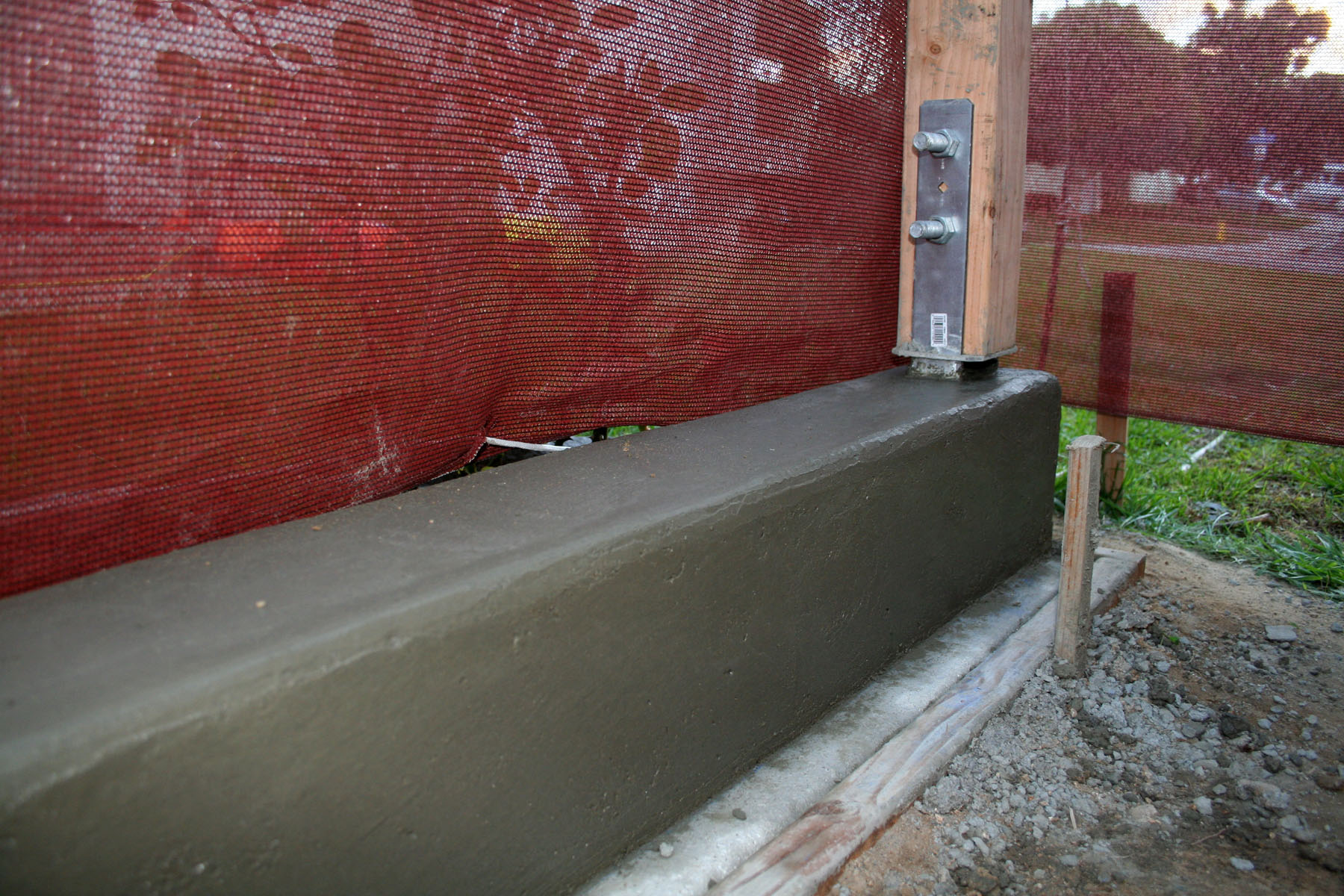
It is a fine 6-foot side yard privacy fence atop a well-built concrete knee wall that keeps the wooden fence above the grade of the neighbors’ yard, which varies from 7″ higher than our property at the front to 16″ at the back.  The wall is 53-feet long, supported by an 8″ x10″ footer reinforced with rebar.  That baby ain’t going anywhere.  I built it for eternity.

It replaced the most rotten, crumbling, too-short falling down fence you ever saw, which was a completely inadequate division between my private backyard homestead and a really obnoxious neighbor.  The lady and her kids are quite nice, but this guy is loud, dumb, and intrusive.  I’ve had ample opportunity to develop a deep-seated dislike of his personality just listening to him blaring his weirdness from 20 feet away.  He yells at the kids and the dog.  He’s mean to my favorite neighbor lady friend on the other side.  Then he pokes his head over the falling-down fence and tries to start a conversation with me at 7 am when I’m in my pajamas with pillow face.  I had to build this fence, people.  It was a matter of survival.

Tearing down the old fence didn’t take all that much muscle, as the termite-eaten boards were light as a feather; it just had to be wrangled apart, posts wiggled out, and the whole load driven to the landfill.  But living without a fence between the two yards, no matter how lame a fence it was, is not acceptable in suburbia.  So I bought what seemed like a vast length of shadecloth fabric, affixed grommets to the top and bottom edge, and strung a construction screen from conduit poles to work behind.  It worked pretty well although it didn’t completely block line of sight, and blew over a couple of times during heavy rain and winds, but served the purpose of separating the yards and keeping the neighbor kids from just wandering through.

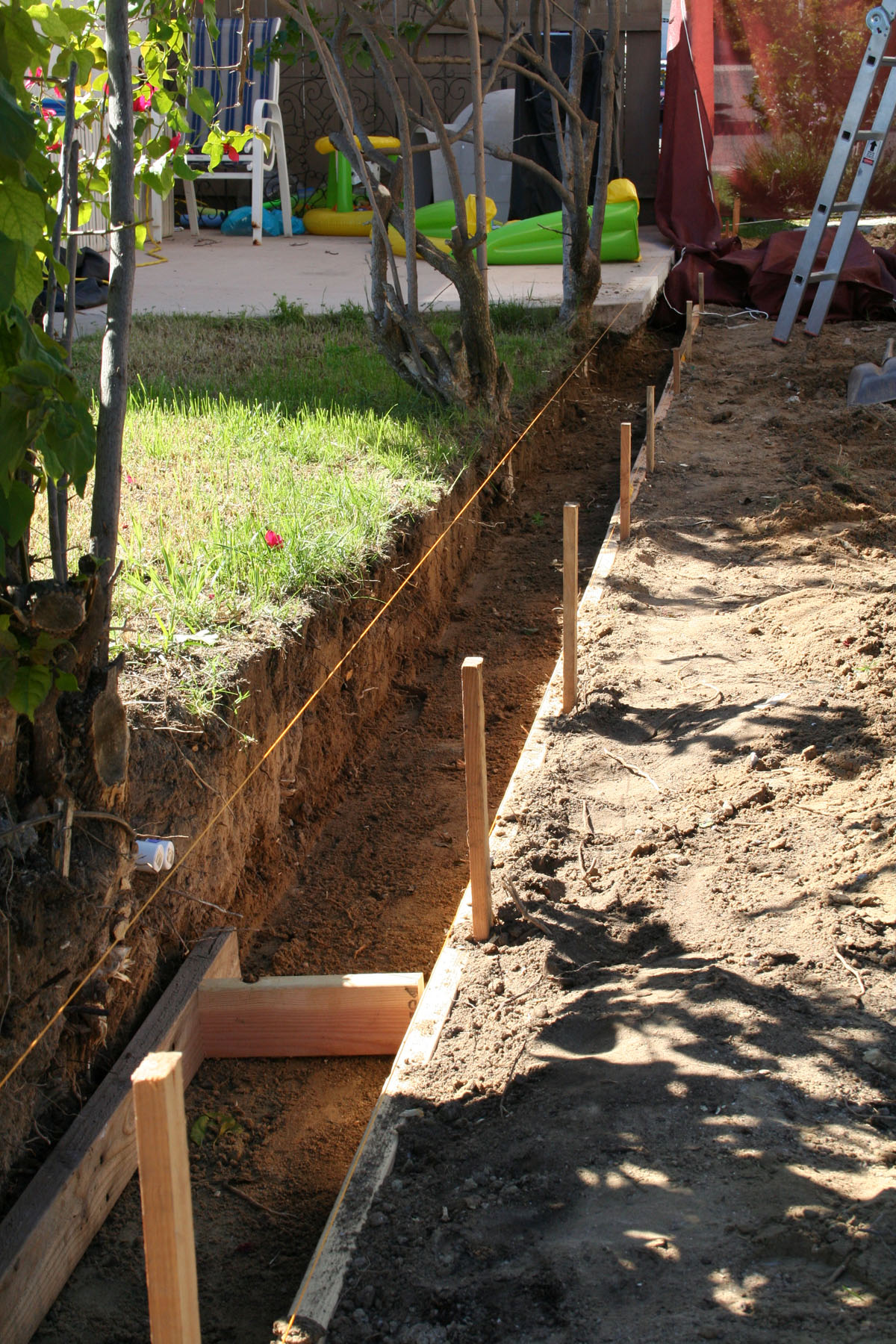
Then the digging commenced.  I planned to form a 10″ x 8″ footer centered on the property line, and once the fence was down it became clear just how much excavation that would require.  Plus, the ancient bougainvillea bushes on the neighbor’s side had been planted right next to the old fence line and were terrifically overgrown, so they had to be radically trimmed (ouch!) and as the footer trench was excavated, roots sawn through and removed.  Lotsa roots. 

It probably took me the better part of two weeks to get the fenceline cleaned up and ready to form for pouring the footer.  The fabric screen went up and down several times, needing moved back as the dimensions took shape and the need for more space to work became apparent.

As we have no frost level to speak of here in San Diego, I started my footer right at ground level and only made it 8″ deep.  Which is still overbuilt for this light-duty application, but that’s how I like to do things.

  The top of the form is nothing more than oiled 2 x 4’s fastened together and plumbed to stakes.  A  jig built from two 10″ crosspieces and a short board made setting the level and width of the far side relatively easy.  Once the form boards were in and level, I finished digging out the remaining 4 – 5 inches, ran rebar down the length, and fixed 2×3’s along the center to form a key slot for the wall to bond to.

One of the biggest challenges I encountered was working around the edge of the 16-foot slab that the previous neighbors had poured right up to the old fence.  We called a friend over to cut it even with the property line and I poured the footer underneath it, thinking I could somehow form the wall around the dang thing and incorporate the edge within the new concrete.  As I got closer to wall construction I decided the slab needed cut back again, and the new cut edge became one side of the form for the first, low wall section.  Of course, I had to buy a honkin’ saw to get the job done.  Every girl needs a worm-drive Milwaukee saw with diamond blade, don’t you think?

First wall section (about 23-feet long, 7-inches high) formed and ready for concrete:

Front wall section poured, Thanksgiving weekend.  I needed to get the front part of the fence and gate built and the backyard closed back up before we left on our December trip, so I worked at it very steadily and took advantage of the holiday weekend.

The project got a huge boost toward completion when my sister arrived for a week over Christmas and offered to help finish the rest of the wall.  What a great Christmas present!  The weather cooperated, amazingly, and we targeted New Year’s Day for the big pour. 

January 2nd, we poured the last section, the 16-inch high portion.   I lost count of the number of bags, sorry to say.  It was a LOT of concrete though.

I was very pleased with how it turned out, and it was a great learning experience.   Although I’ve done a few concrete projects before I’d never built a concrete wall, and figured this out bit by bit, reading books and adapting instructions to fit my particular situation.  The forms held well, the posts are aligned and plumb, there is rebar running through for strength, and it looks great.

In addition to forming and pouring concrete, the fence boards got two coats of stain, both sides, prior to putting them up.  It is much easier to paint a fence before it’s built.  But it was a patience game, since there were too many to lay out all at once and painting one side at a time meant flipping twice, allowing for drying in between.  Several nights of drizzle set the paint job back until I learned to cover the freshly painted boards with plastic overnight.  The job seemed endless, but I persisted with it, working by worklight in the evenings during the week, and was able to finish building the fence atop the wall by January 6. 

(I never know what vertical reference point to anchor these perspective photos to.  The fence is straight and plumb, as is the house, really.)

I am glad it’s done, and glad it turned out well.

Catching up

Yikes, nearly a month gone by without an update.  So much for that New Year’s resolution to post more regularly!

Truth is, I’m out of the habit, and spending an awful lot of time projecting, so free time is truly limited.  One habit I have gotten into, though, is working at least an hour a day outside after I get home from work, often by halogen worklight.  It has really helped me wrap the big fence project up, but it cuts my evenings short inside, leaving just enough time to cook and eat dinner before I have to drag my old bones to bed.

And of course once enough time passes, it can be difficult to find an entry point back into the journaling stream, so much has gotten done and should be reported on.  This fence project, for instance, which none of you’ve heard a thing about but I’ve been working on since mid-October.   I wish I would have written about it a little at a time as it was progressing, instead of leaving it to the end to describe start to finish.  There’s a trick to that I have yet to learn.  It doesn’t help that I’m not a speedy writer, and these days my thoughts are more scattered than ever, so sitting down and capturing a day or two’s worth of happenings seems to be a huge challenge.  I doubt I’m alone in this, though.

But, the side fence is finished, glory hallelujia.  I learned to pour concrete walls and gained a lot of confidence in my ability to see a major project through from just an idea to completion, the product of my own labor.  Yes, I had a little help, but most of the work was mine, and the result delights me to no end.  I’ll give a proper rundown of the whole thing start to finish in a separate post, complete with pictures.  Tonight, I want to just get back to updating, and move forward.

Most weekends I make a to-do list like the one above, starting it bleary-eyed over a hot cup of Saturday morning coffee and adding to it as the day progresses.  I put everything on it I want to get done, whether it seems like too much or not.  I find the challenge of lining things out helps me use my time better, keeps me motivated. 

I didn’t get everything done on my to-do list this weekend, but I came darned close, as you can see.  Last weekend I built a firewood rack and set it up on the New Fence side of the house; this weekend we picked up a half-cord of firewood, two trips in my little truck, which looks to be more like 3/4-cord, so I had to build another rack this morning to unload the second truckload.  Got all that done before noon, in time to listen to the 2nd half of Praire Home Companion that I missed yesterday.  I just about fell asleep out on the back patio listening to the radio, so I went in and took a 30-minute nap.  That wasn’t on my list, but I needed it.  Naps are good.

I’ve started a Ladies Fitness Club with the girls at work, more of a support group than anything, prompted by the need to help one of our top Sailors get back within bodyfat standards after her pregnancy.  She and her husband just bought a house a few blocks from us, so I’ve talked her into getting together to walk her dogs out on the chapparal trails as often as we can.  We started today.  It’s good to be out moving my body again like that.  And the dogs are great therapy.

Leftover meatloaf-and-home-canned-veggie shepherd’s pie tonight, a fire in the fireplace, blog post nearly done.  Good weekend.


Two farm trips have come and gone since my last post back in September, and now that I have finally regained my voice here I must say it has been a long three months filled with both tragedy and triumph, and my spirit has been tested.  During the hard parts I could only barely keep pointed in the right direction, and when the pendulum swung back to the bright side I did not have the heart to speak of just the good things happening.  A little hard to explain but that’s the best I can do for now, and must be said however cryptically so I can move on and resume this story.

Better bloggers than I could have kept the thread going throughout; I truly lost my voice and had to trust that it would come back eventually, and that the silence would be understood.   I hope it has, as I’ve missed being here.

I bought this big dually truck in September and we drove him out to the farm this time, three days on the road and mostly through Texas, returning late Wednesday night from Louisville and just missing the torrential rains here in San Diego.    We were pleasantly surprised by the 4 inches of snow on the ground when we rolled into our last fuel stop in Columbia, Kentucky last Tuesday, and despite a couple of days of freezing rains that kept us holed up and the cold temps that kept us bundled up, the week there at the farm was a great success.

Grizzly the Farm Truck is back home in Kentucky now, snug inside the barn with a trickle-charger to keep his big new batteries topped off, and a Kentucky Farm plate on his bumper instead of California’s highway robbery signs.  The year of registration in the Commonwealth will cost a third of what the Golden State would have wanted paid (due again 31 January !) and his insurance is less, too. 

It was touch-and-go on getting the title, which got lost in the CA DMV system, reissued and sent to Taylor County to coincide with our visit.  I made a half-dozen phone calls and talked to some really disgruntled DMV clerks before I realized it wasn’t where it should have been, but the rush reissue arrived (just in time) the day before we had to leave, and I walked out of the county clerk’s office with his new plate and that same huge smile you see in the picture above on my face.  It was a pretty major triumph, since timing is everything with these trips and I could not have gotten him registered without that title getting resent as quickly as it did.

Let me pause here and acknowledge the chuckles about my truck’s name.  Yes, I name every damned thing with an engine, or should I say, they name themselves.   I find it easier to call my vehicles by name, rather than saying “the tractor” or “the big truck.”  And I swear they have personalities, too, so they get names that match.  Griz named himself with his big growling diesel engine and ponderous back-end girth.  It fits, so it sticks.

Along with getting the truck out to the farm and registered in Kentucky, this trip’s major project was building the hearth pad for my little wood stove, which is still sitting out in the barn on the shipping pallet, waiting to be installed where the fireplace once was.  We had removed the fireplace a bit at a time over the past few visits, as it wasn’t exactly a simple demolition nor was it the only project going on.  But this time we finally got all the remnants of fireplace chimney out and I was able to lay the concrete backer board down and tile the corner with slate, with a raised pad for the stove to set on to make loading wood a little easier.

It was a great indoor project for a cold, blustery wintertime visit.  The stones atop the stove pedestal are remnants of the fireplace hearth “stone,” which was really faux stone concrete that I cut apart with a diamond blade saw.  It looks just like stone, so I wanted to save it and re-use it for under the stove, but it turned out to have a core filled with some kind of high-density foam.  Oh, dear, we thought – this won’t work at all.  Then Bear got the brilliant idea to chisel out the foam along the edges of the blocks and fill in with mortar to the level of the concrete parts, making a flat, durable “stone” edge with just a little of the foam core in the middle.  A little duct tape and cardboard for forming the edges and 5# of mortar worked perfectly.  It took more time than I would have liked, but the end result was worth it, and I couldn’t be more pleased with how it turned out.

Here is a picture I found of what the fireplace looked before.  It was pretty useless as a way to warm the house, pulling all the warm air up the chimney with the fire, so the folks never used it, as you can see by the chairs facing away.  It mostly just filled the corner and served as a shelf for knick-knacks.  Their electric bills during the winter, though, reached up past $300 in the coldest months, so I resolved to put a wood stove in for my own use, surrounded as I am by more firewood than I could possibly use in a lifetime.

You can barely see the hearthstone we once thought was four large stones mortared together.  And the “rock” on the face of the fireplace, turned out to be just concrete faux stone, too.  Heavy son-of-a-bitch, that panel was.

The wall behind the stove will be a heat shield, consisting of backer board installed atop 1″ ceramic spacers to create an air space and prevent heat transfer to the combustable wall, tiled with the same slate as the hearth.  Building a heat shield behind the stove allows you to install it closer to the wall – as close as 12″ from the stove back, instead of the 30″ clearance needed without the heat shield.   My stove will sit about 18″ away from the wall, but the heat shield is still a great precaution, especially in a mobile home.  And it will look fabulous, taking that beautiful slate all the way up to the ceiling.

You can see two sheets of backer board leaning against the wall behind the hearth in the photo – what you can’t see is that I had to remove the 1/4″ drywall behind the stove in order to add 2 x 4″ reinforcements between the studs, which weren’t adequately spaced to hang the heavy concrete board with stone tile, mortar and grout added to it.  So, this project will have a second phase, the heat shield wall installation, as well as a third phase, which will be installing a new stove-rated chimney and double-walled stovepipe, and dragging moving the 500 lb stove inside to its permanent place atop the hearth stones.  Here is a stock picture of our stove from the Woodstock Stove website:

I bought this stove two summers ago, when the folks were still living in the little house, and when we spoke about installing it they seemed to think it would be a simple thing to just toss it in the corner.  Bobby actually went out and cut some hickory firewood in anticipation of building fires.  The folks moved to Oklahoma two September’s ago, leaving that stack of hickory firewood to season nicely for my stove fires next year.   As it turns out, these things take time; projects like this don’t get finished (or even started) overnight, and here we are two years later, and I’m just getting the hearth built.  And I’m fine with that, because like I always say to myself, it sure will look good when it’s done.

Back here at Bear and Thistle West, the sun is shining, there’s post-storm cleanup to be done, and I have family coming for Christmas Eve dinner (beef stew and fresh-baked bread – y’all are welcome to drop in!).  It’s time to publish this post and get a move on. 

Merry Christmas to anyone still reading – may your holiday be filled with warmth and love and friendship, and lots of good food!

There I go again

With the not posting!  Unfortunately, it’ll be a few more weeks now before I’m able to get back to it.  Life = whirlwind, and all that.

Mostly though it’s just that I fell out of the habit, and now it is time to do end-of-summer farm chores, my reward of sorts for working such long hours these past months.

I shall return with pictures and videos and much rambling of plans for this and that.

Later,

Kay

There aren’t words enough in my writing repertoire to describe the awful crush of work both at home and at the squadron this past month, or explain why it is I left off 5 weeks ago with a post about baking bread and then, this long silence.

Sometimes we just have to do what needs done to survive, amidst the frenzy of events and demands on our time and energy that life throws at us.  That pretty much sums up July/August for me.  I am hopeful that the whitewater rapids are behind, and I can paddle at a slower pace now without fear of flipping over and drowning.  I am exhausted, my arms ache, and I need a rest.

Amidst it all, I kept up with the summer vegetable harvest, the bread baking, the hanging out of laundry, the bill-paying and lawn mowing, while Bear was out at sea.  And my plodding, just-in-time, herculean efforts in the garden saved 40 beautiful heirloom tomato plants from certain death in the recent August heat, which makes every drop of sweat worth it. 

The picture above shows only the starting point of preparing their permanent growing bed; once again, words fail me, or perhaps I’m just being lazy, at describing how much damned work it was.  You can see the huge clods of hard-packed granite fill.  You can see the tomato plants perched on the wall, peering down, hopeful and expectant for rich, moist, deep soil to fling their roots into.  I was caught in between, and it was only their soulful urging and the promise of the harvest to come that gave me the energy and will to finish this project.

Yes, my tomato plants begged me to persevere, and for them, I did.  I could not have done it without their voices in my ear every time I went down to water them in their little pots.  The digging and hauling out of the granite went so slowly and my time was so limited, I had to repot them into 1-gallon containers to buy another 2 weeks of time.  And in the nick of time, my dear friend Liz offered to haul a load of topsoil in last Sunday, enough to finish filling the bed and get my babies planted before the heat arrived.  Thank you so much, Liz.  My choir of tomato plants are singing your praises, can you hear them?

That’s 38 lovely tomato plants settling in to 75 square feet of deep-dug heaven, each with a 7-foot pole to climb and hold onto as they reach for the sky.  If it seems a little late to be starting tomatoes, keep in mind this is San Diego, where our spring-like autumns let us harvest tomatoes all the way up to Thanksgiving.  I am hoping for a deluge of fruit in October, and shall prepare to can and freeze as much as possible – tomato sauce, canned diced tomatoes for cooking, salsa, tomato paste, maybe even some ketchup this year.

In my kitchen, you can never have too many tomatoes.

sourdough bread, no-knead version

 I’ve always loved baking my own bread.  My journey into the art and science of breadbaking started many years ago as a teenager still living at home, experimenting with recipes and flours, amazed at the flavor and crunch and freshness of a hand-made, fresh-baked loaf. 

Through the years I have tried many methods, with as many failures as successes, but I’ve never stopped making bread.  Mostly I mixed and kneaded dough by hand, the long way, with long proofing and rising times, resulting in bread that took four or more hours from start to finish.  Delicious, but a lot of work.

When Bear and I married, we got a Chefmate bread machine as a wedding gift; one of the first bread machines on the market, I think.  I still use it today, mostly for kneading and rising my multi-grain hamburger bun dough, and for making specialty wheat-free breads when the occasion arises.  I’m not sure why, but the non-traditional doughs mix and knead really well in that little machine.

A few years later I bought my trusty Kitchenaid stand mixer, and I was convinced the dough hook was the easiest way to knead bread ever invented.  I still use the 60-Minute Roll recipe from the book that came with it (simply awesome!)  but I no longer make our daily bread “the long way” as I refer to it now.   Goodness, no.  I wouldn’t be baking all our own bread if I were.

Then one of my favorite magazines, Cooks Illustrated, featured the “almost no-knead” bread recipe in their January 2008 issue, taking the original New York Times’ version and adding a smidge of vinegar and lager beer to boost the flavor and mimic rustic sourdough bread.  I was a convert after the first loaf, and have never looked back.  Being a beer drinker back then, I always had some Sam Adams or wheaty micro-brew in the fridge, and already owned the necessary cast iron dutch oven to bake it in, covered, at 500 degrees, which gives the loaf a rustic crisp crust.

The “no-knead” part is no lie.  The no-secret of it is a process called autolysis, which is a period of rest that allows the dough to relax. After the initial mixing of flour and water, the dough is allowed to sit. This rest period allows for better absorption of water and allows the gluten and starches to align.  Essentially, most of the kneading is done for you by allowing the flour and moisture to work together over the long rest period. 

The original recipe calls for mixing ingredients into a “shaggy dough” which is covered tightly and given an 8 – 16 hour autolysis; I’ve found an overnight session, up to 24 hours, works very well and makes this method quite compatible with a working person’s daily routine.  In other words, I can mix up a batch of shaggy dough one evening, cover and let rest until the next day, and simply shape into loaves in a few minutes’ time and bake the next evening.  The baked loaves are cool enough to slice and bag for the freezer before going to bed.  All in a day’s (or two day’s) after-work routine.

The foray into developing my own sourdough starter eliminated the instant yeast and beer/vinegar additions and greatly simplified the mixing process.   My weekly two-day breadbaking process now typically goes like this:  I pull my starter out of the fridge on Friday morning, feed it with fresh flour and water and cover it with plastic wrap.  Friday evening I mix a shaggy bread dough using the proofed starter, flour, and additional ingredients;  cover, and leave overnight.  Saturday morning, afternoon or evening – the choice is mine – I shape the now-elastic dough into loaves with a few minutes of kneading and a scoop of flour, place on slings of parchment paper in skillets to rise for 2 hours, then bake in cast iron dutch ovens in a hot (500 reduced to 425) oven for 30 minutes covered, 15 uncovered.

A double batch yields two large round loaves that provide lots of breakfast toast, sandwich bread, and supper menu accompaniment for the week.  Perfect for two hard-working, hungry adults. (If I had kids, I would have to make more than two loaves.)  Is the bread perfect?  Well no – though it usually looks like the photo at the beginning of this post, sometimes the loaves are smallish, and a little more dense; sometimes they’re larger and rougher like the one I’ve got proofing right now.  It depends a lot on the moisture content of the shaggy dough, the environmental conditions, and such.  I’m happy when the bread is edible, which is always.

Besides allowing this overnight bread dough to almost knead itself, the autolysis period (moist dough resting long time) and the acidic fermentation of sourdough starter together provide the significant nutritional benefit of reducing the phytic acid content of the wheat flour, which leads to increased bioavailability of many nutrients, enhanced magnesium and phosphorus solubility, as well as boosting enzyme content.  In other words, this bread digests very well, is remarkably healthful, and it is possible that even gluten-intolerant types might be able to eat it safely.

I’m a bread-eater and always will be; this method of bread-making allows me to enjoy my own fresh-baked, healthful sourdough bread every single day with minimal fuss and effort.  It’s a small victory, a minor battle won in the war we’re all fighting to take back control of our daily food, despite the onslaught of convenience-driven choices in the supermarket and insane demands on our available time.

I’d be happy to share my experience with developing a sourdough starter and the recipe I’m currently using for my daily bread – just holler.  Got a loaf ready to put in the oven right now – enjoy your Sunday evening, all!

Keeping up

…just barely.

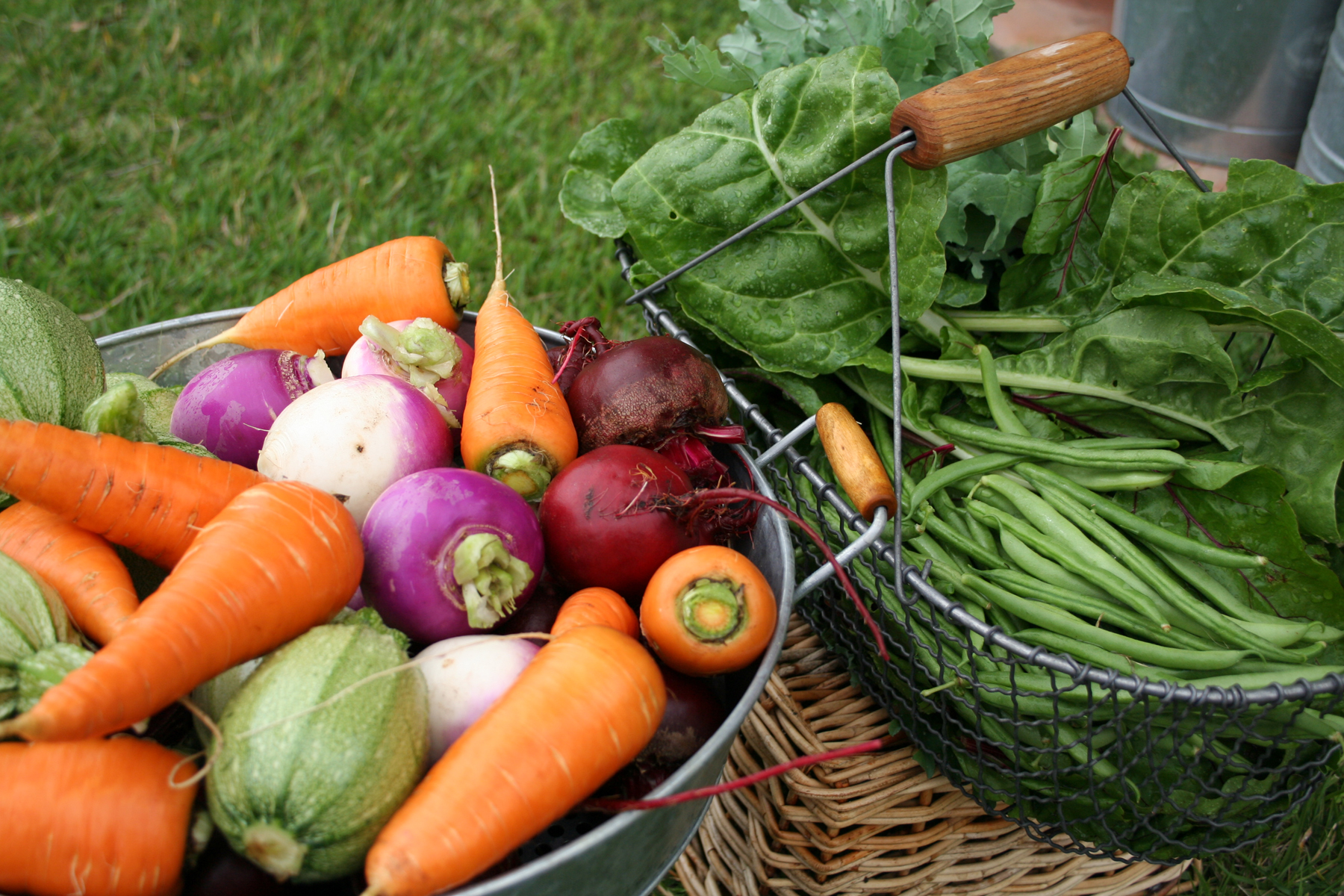
I would have loved to have eaten or processed all the food in this photo the same day I picked it and hauled it up the hill stairs, but it will wait a couple of days in the fridge until I can.  Life and work is hard right now and I’m grateful for a small (but productive) garden that only requires a little daily attention.

Best garden I’ve ever had, my whole life.  Can’t ever remember hauling baskets and trugs of loot into the kitchen like this, have always been grateful for every tiny handful plucked from a few square inches.  This bounty makes my heart roar with hard-earned satisfaction.

This weekend’s haul:

Turnips:        3 lbs 11 oz

French zuchinni:      5 lbs 13 oz

Pole beans:      2 lbs 11 oz

Carrots:     2 lbs 6 oz

Beets:     2 lbs 3 oz

Beet greens, chard:    big bunch

Red Russian kale:     big bunch

Plums:     4 lbs 6 oz

A lot of food.  I’m swimming in fresh food.

Bear is on travel for a few weeks, halfway around the world on an aircraft carrier teaching young kids how to troubleshoot and fix electronics.  I am glad he’s not here this month, as work is crushing my head into a flat, stupid pancake, and I am spending way too much time at just trying to keep up.  This is a sign of the rightness of my choice to exit stage left in 16 short months.  My professional sharpness has faded, the farmer in me wants out, and my brain is tired of struggling to map out strategies for an enterprise I’m no longer committed to.

The young folks, I remain passionately committed to.  So much so, it brings me to tears sometimes in front of them when they “get it” and find their power to change their corner of the Navy.  The enterprise, the unit, I could give a shit less about.

But my garden elates me.

Quiet weekend

It’s Monday evening, and the long, lovely three-day weekend has finally come to a close, as they always do. 

Bear and I celebrated our 15th anniversary yesterday, quietly, at home, over a delicious beef roast, garden vegetables, and a cold bottle of champagne.  Fresh-baked apple pie made from our own apples, and vanilla ice cream for desert; we couldn’t eat another bite. 

After the movie we stepped out back to listen to the distant rumbling of fireworks and catch a far-away glimpse of the grand finale bursts of light and color.  It was just enough to make it feel like it was the Fourth of July.  Then went back in and watched the Boston Pops fireworks on television afterward, amazed at the extravagance.

I didn’t work too hard this weekend.  Ran one of the piles of old ice plant through the shredder on Saturday, and built a new compost pile from the mulch.  Harvested vegetables, froze some zuchinni, hung laundry out in the sunshine.  Did a bit of online reading; farming is much on my mind these days.  Sent some e-cards for the holiday.  Finally finished filing taxes, yay (we had an extension, don’t worry).

Bear will be on the road this coming month, first a week in Connecticut then nearly four weeks in Japan.  July will fly by with him gone.  So much to do, though.  It’s time to make travel arrangements for our farm trip in September, and I need to get that second garden bed dug, for my tomato plantation.  All in good time, I hope.

My garden is growing like it’s on steroids.  I am not complaining.  A band of little lizards patrol the lush jungle, alternately soaking up the sun on the cement blocks and dashing through the beans, tomatos and squash for yummy bug treats.  I love my little blue-bellied reptile friends.

Long week ahead, it may be quiet here.  Hope the heat isn’t too bad where you are.