Feeds:
Posts
Comments
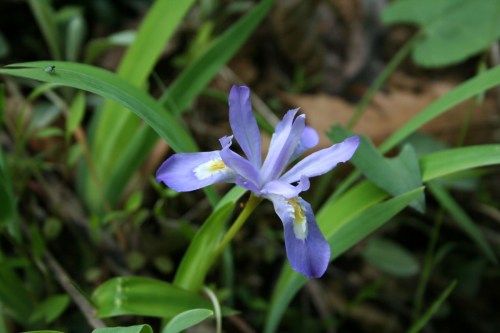
Iris cristata

We got back from the Farm late last Saturday night, escaping the onslaught of rain heading up from the South that turned Derby Day into a mudfest.   Of the eight days there, four were entirely rain-free, which is as good as it gets, though we made good use of our time, rain or shine.

My primary project this trip was restoring (sanding, grinding rust, and painting) the 19 corral panels I’d hauled down from the pastures in February and stacked in the shop.   They’d been out in the weather for years, and were rusting in many spots and badly in need of a good coat of Rustoleum paint.  I regret not taking before and after pictures, as the transformation was amazing, and made me feel good about spending the time and effort to do the job right.

I didn’t get them all done, just 7 of the 19, but I’m all set up now with my grinder and sawhorses and techniques, so everytime we visit I’ll try and knock a couple out, so that when I’m finally ready to set up the round pen/handling pen, they’ll be ready too.  What a lot of work it was!  I started by washing them down with a sandpaper sponge to get as much dirt, rust and oxidized paint off as possible, then took the grinder to every last little rust spot, then applied a coat of primer to the bare metal exposed by the grinding, then a lovely green coat of Rustoleum.  Laid horizontal on sawhorses at waist level, the panels were easy to work on, but the enamel paint had to dry overnight or all day in between coats, which was the bottleneck of the whole process.

So I was grateful to get done what I did, and most of it was inside shop work while the rain came down, a very good use of time.

We had a couple of sunny days following the rain, which allowed me to finish pulling fence posts up on the pastures, removing the last of the ill-placed and unused lanes and gates that surrounded the Big Pond.  We never could figure out why the old man had set everything up so close to the pond, the ground was mucky in spots and not even close to level.  I’ll find a better place for a handling pen and loading chute as the design of things unfolds, and yes, it’ll be a lot of work to set it all back up again, but I’d rather do that than keep using a setup that makes no sense and doesn’t work well.

I spent a day fixing and cleaning house and shop gutters, right before the big deluge came, before we left.  Good work to get done before loads of rain arrived.  And we found someone to mow the grass, which is a blog post all in itself, about meeting neighbors and being embraced by the local community.

A good visit, all in all.  My camera came out only once, I regret, to take pictures of wildflowers in late-April bloom.  I think I got lazy about photojournalizing my work projects, which I’m kicking myself for, but the work got done, whether you have pictures of it or not. 

The wildflowers were astonishingly beautiful.  More photos to follow.

This week I’m attending a Transition Assistance Program class, a program sponsored and presented by the Department of Labor with the intention of ensuring a successful transition from military service to civilian employment for servicemembers leaving active duty.

We’re actually required to go through this training, and are encouraged to attend at least a year before separation, but you can go earlier.  Many people put it off until they’re within 6 – 8 months of retiring from the service, staring their transition right in the face.  I’ve got 19 months left.  Quite a difference, and a decided advantage, in many respects.  I’ve always heard people say they wished they’d gone to this transition seminar earlier, that the information would have done them more good had they had more time to do something with it before their exit date.  So I’m going now, and it’s a good thing.

The curriculum covers a lot of territory, including an in-depth discussion of VA benefits and retirement planning; but it’s mainly a crash course in How to Find a Job in The Civilian World.   Personal skills assessment, interview and networking techniques, and resume writing are the main focus. 

I’m an anomaly in this class, the only attendee that is not planning on going to work for someone else when they retire.  This surprised me a little bit, but I’m getting used to being the oddball.  Agrarians among warriors are few. 

As we went around the room introducing ourselves the first day, everyone was asked to give a brief description of what type of job they are doing now, as military professionals, and what career field they intend to transition to as civilians.  Nearly all of this group of soon-to-be retired senior officers and senior enlisted folks mentioned looking for jobs in the Defense Industry, as contractors or civil service employees, working at the senior executive level. 

When it came my turn, I got a lot of smiles when I told them I was going to be a farmer, starting my own pastured livestock farm business.  I didn’t elaborate, I didn’t tell them that along with all the other myriad enterprises that will eventually comprise Bear and Thistle Farm, this will be my life’s work.  Just kept it simple and businesslike.

As the class progressed, I realized that all the information on resume writing and how to dress for and do well at an job interview was not specifically useful to me, at least not without a little filtering.  So I took the suggestions and applied them to the kinds of interviews and networking I’ll be doing:  meeting with loan officers for business financing, contacting potential customers, and building relationships with suppliers, fellow farmers, and other professionals. 

Another useful concept I garnered from this training was something called an informational interview.  In job search lingo, this is a technique used to gain knowledge of and establish contact with a company, under the rubrik of conducting “research,” without appearing to be overtly looking for employment.   The idea is to get a 20-minute interview to learn about the industry and company without pressuring the person for employment, all the while building a relationship and getting a non-threatening foot in the door.  I see the potential to use this technique doing market research and establishing networks and liaisons with fellow farmers, as I continue to craft my business plan.

Yesterday we prepared our “30-second commercial” which is another term for an “elevator speech,” that verbal snapshot anyone trying to connect in business will have at the ready should an opportunity for networking arise.  Of course the outline in the workbook was built on questions related to someone trying to get a job, introducing themselves and their experiences and strengths to a potential employer, whereas mine will introduce my farm enterprise to potential customers and other interested persons.

Speaking of interviews, I had the pleasure of doing a phone interview a week ago about my farm plans with Sylvia Burgos Toftness, an Acres USA grazing school classmate who is also starting a grass-fed grazing operation with her husband in Wisconsin.  Sylvia is combining her talents and long experience as a communications professional with a love of food and a passion for grass-based farming to foster a network of like-minded people through her website and blog, Bronx to Barn.  Listen to the podcast of our conversation here.

Like I said at the end of our interview, I’m thankful for the lead time I have, these 19 months before the big moving truck comes to take me and my tools and things out to Kentucky, to start this farming in earnest.  I have a lot of work and planning to do, and much to learn.  But the transition from warrior to farmer has definitely begun.

A time to build

I’m not the only one building things around here, as it turns out.

Just six feet from the sliding glass door on our back patio, a hummingbird has chosen to construct her nest atop a very small wind chime, hanging under the eaves next to the house wall.

And at the edge of the patio, just 12 feet or so from the door, the birdhouse hung under the shade roof eaves is hosting the pair of canyon wrens for the second year in a row.  Construction is in full swing on both nests, despite my constant presence and movement in the yard as I continue to work on terracing the back hill.

I’m delighted, and honored, to have them both here.  It seems a little close to our bumbling human activity, but who am I to judge?  Birds know what birds need.  Neither species seems to be excessively bothered by our presence, carrying on with their nest-building right in front of us; we do, however, give them the courtesy of quieting down our movements when they’re up at their nests or moving to and fro. 

The canyon wrens are now at the small twig stage, having started last week with large (for them) branches, tugged into the small hole, to fill the bottom of the box.  Now they’re just bringing in short, slender twigs, I presume to finish off the inside of the nest.  Every now and then though, one of them will try to cram in a branchy twig that gets caught on the front of the birdhouse, and it’s rather comical to see how many times they’ll try to push it in against all odds.  Persistent builders, these birds.

I had to research the habits of nesting hummingbirds a bit, to find out how many eggs they lay, how long it takes to hatch them, and when the youngsters fledge.  Turns out it’s two eggs that take 16 – 18 days to hatch, and a couple more weeks for the naked hummer babies to grow feathers and figure out how to fly.  It’ll be interesting to watch, if Mrs. Hummer decides her nest location is safe enough where it is to go through with the whole process.

Last spring, just after I got back from Africa, the wrens were furiously feeding four clamerous chicks and after a few weeks, Bear and I were treated to the brief performance of the youngsters flying out of the nest box, one morning when we happened to be out on the patio at just the right moment.  It was very cool to watch.

My building project is moving along, one shovelful of excavated dirt at a time.  Update for y’all tomorrow, perhaps; the afternoon is slipping away and I must get back at it.

We returned from Kentucky to a persistently rainy February in the Golden State.  Total precip was only 2.25″, but it rained 20 days out of the month.  Great for gardens and filling reservoirs, not so good for wall-builders. 

Then March arrived with a hint of lamb, beautiful, warm and sunny, promising weeks of perfect projecting weather.  That all changed the next day.

So it goes.  Of the last 8 weekends, we’ve had rainstorms during six.  Now, there’s nothing wrong with a little rain in southern California – water being the precious, disappearing resource that it is here – but damnit, Jim, I wish it would pour during the work week, so all us movers of soil can get something done on our few days off.

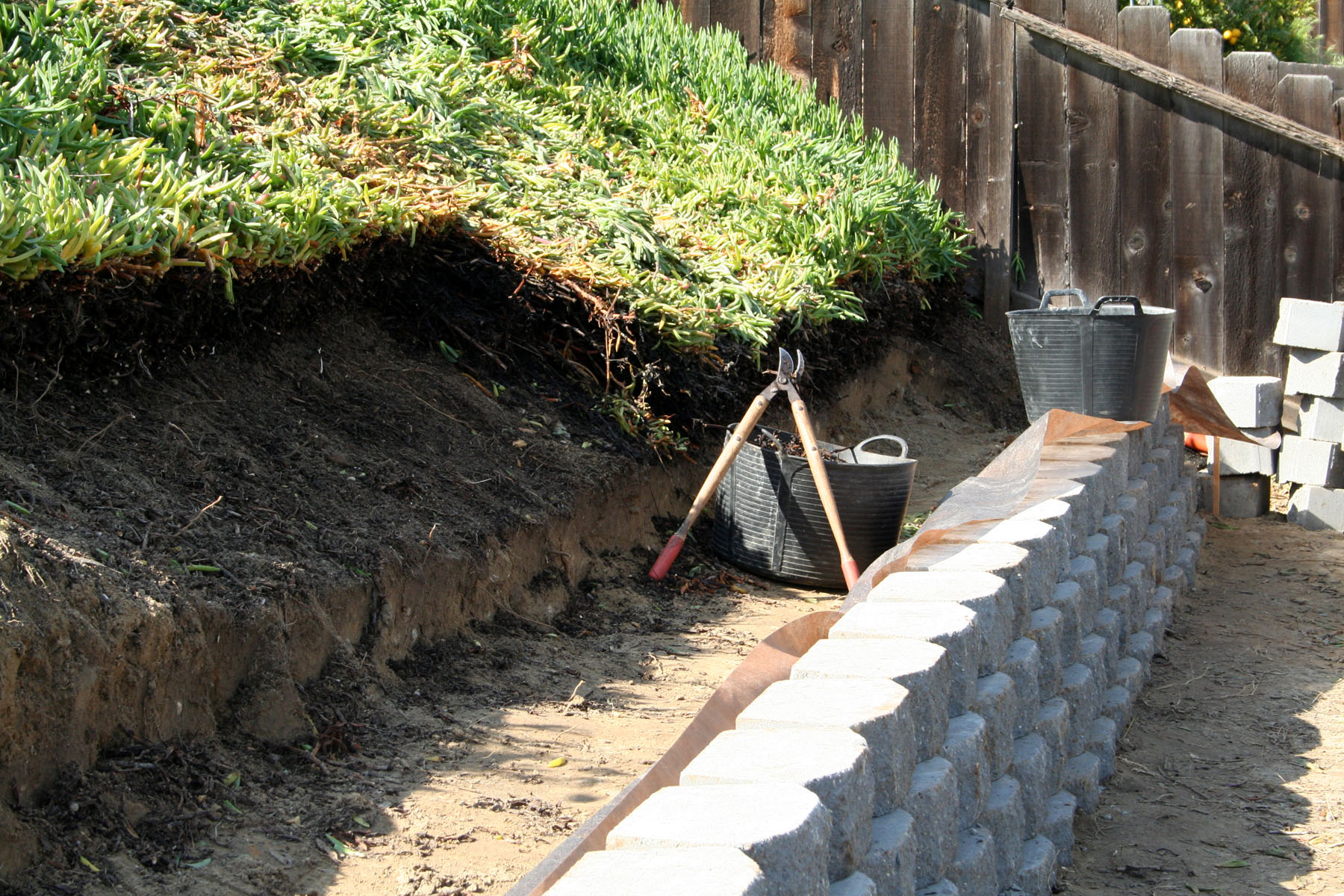
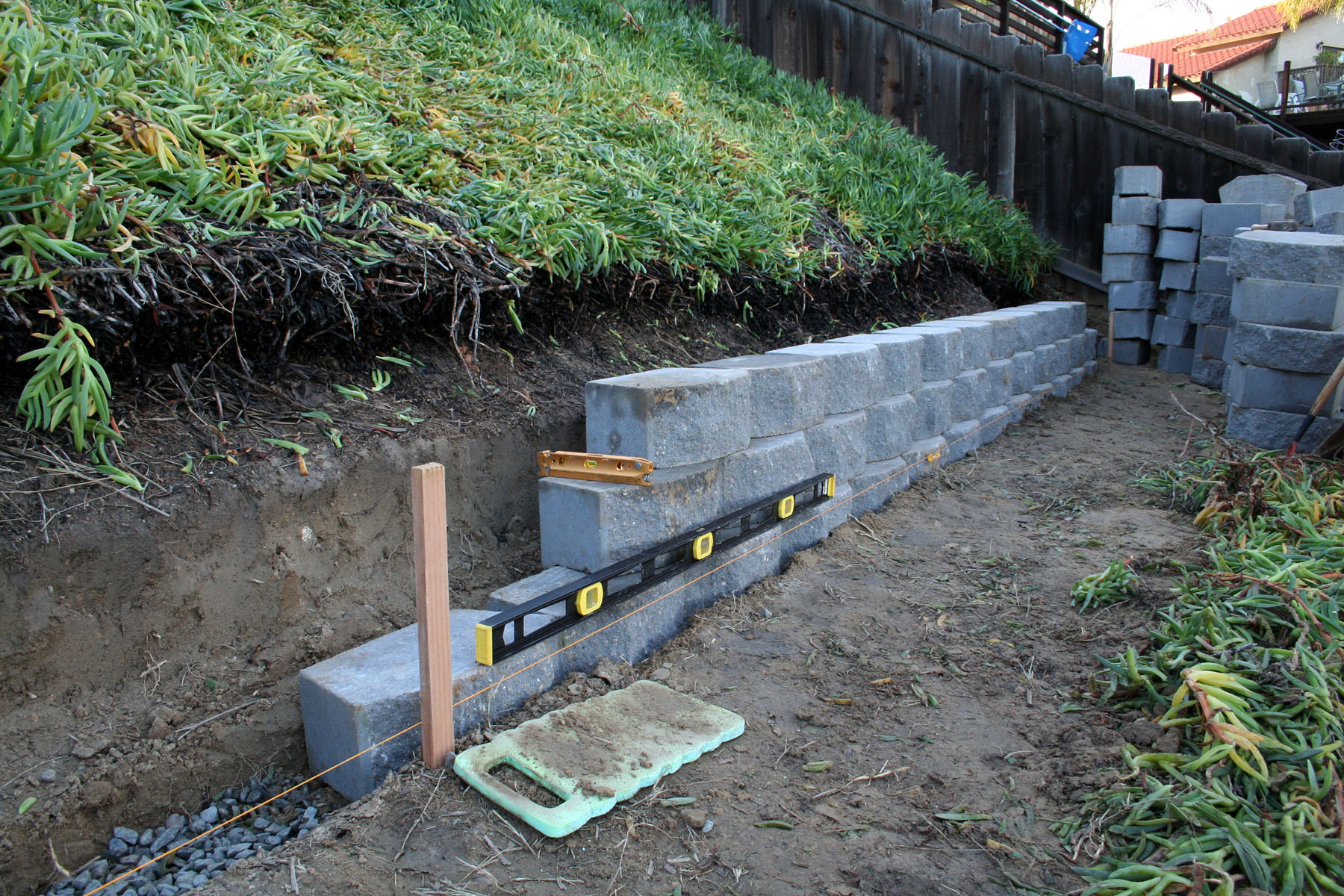
Even so, despite the weather I’ve made slow, steady progress on the back hill terrace building since we returned from the Farm, mostly in the hour or so of daylight after work, since the weekends have been wet, very wet.  As you can see, the second wall’s done, but the hard part of building the second terrace is still ahead.  There’s still an awful lot of ice plant to pull out and shred, and the hill is steeper here than at the bottom, which means there’s more soil to remove. 

I’m slowly working away at both.  With the help of my trusty Troy-bilt chipper-shredder, Chewie (named after the Star Wars Chewbaca), I am turning tons of overgrown ice plant into shredded mulch and building compost piles, lots of them.  I’m not sure how I would accomplish this project without the ability to convert this enormous volume of plant material into something useable, as there is so much of it, and the backyard is very small.  Disposing of garden trimmings here in suburbia usually means leaving bins out curbside for the collection trucks, but with Chewie at my service I’ve never had to let a single branch or pile of leaves go to waste.  This project is, however, the most he’s had to contend with, and it’s slow going, feeding the tangled, fleshy vines and old roots through.  But we’re getting there.

Moving the dirt is slow work, too.  Like the Incas building their high mountain terrace gardens in the Andes, I am carving out and hauling away the overburden by hand, in trugs, some of it going downhill to widen and level out the bottom edge, but most of it will have to be walked up the steps to the top of the yard, and piled somewhere until I figure out how much I will need for fill and what will be excess to give away.  The few inches of topsoil is getting peeled off before digging out the decomposed granite, to add to my stockpile of topsoil for the growing areas once construction is done.  

So the routine has been going like this:  I escape the squadron as early as I reasonably can, drive 40 minutes home through freeway traffic, and head straight out back for an hour or so of work before daylight is gone.  Once it gets dark, it’s time to make dinner, wash up dishes, and drag myself to bed.  Every little bit helps, believe me – last night I carved out  another four feet at the curved corner, and I’m hoping to get enough of the second bed leveled this week to have room to stack the next order of blocks on Monday.  This weekend is Drill Weekend for the Reservists, so we’ll work straight through.  It’ll probably be beautiful and sunny, too!  Just my luck.

But every morning I take a cup of coffee down to the first level and sit to watch the dawn break over the canyon, and listen to the  birds start to wake up and begin their songs, and I’m newly energized to do whatever little bit I can do that day, even if it’s just a few loads of dirt or a couple of trugs filled with ice plant hiked up the hill.  Because I can see the finished project in my mind’s eye, and remember what the hill looked like before I started, and I’m endlessly fascinated by the process of transforming the one thing into the other.  I could pay someone to do this, but it wouldn’t be the same.

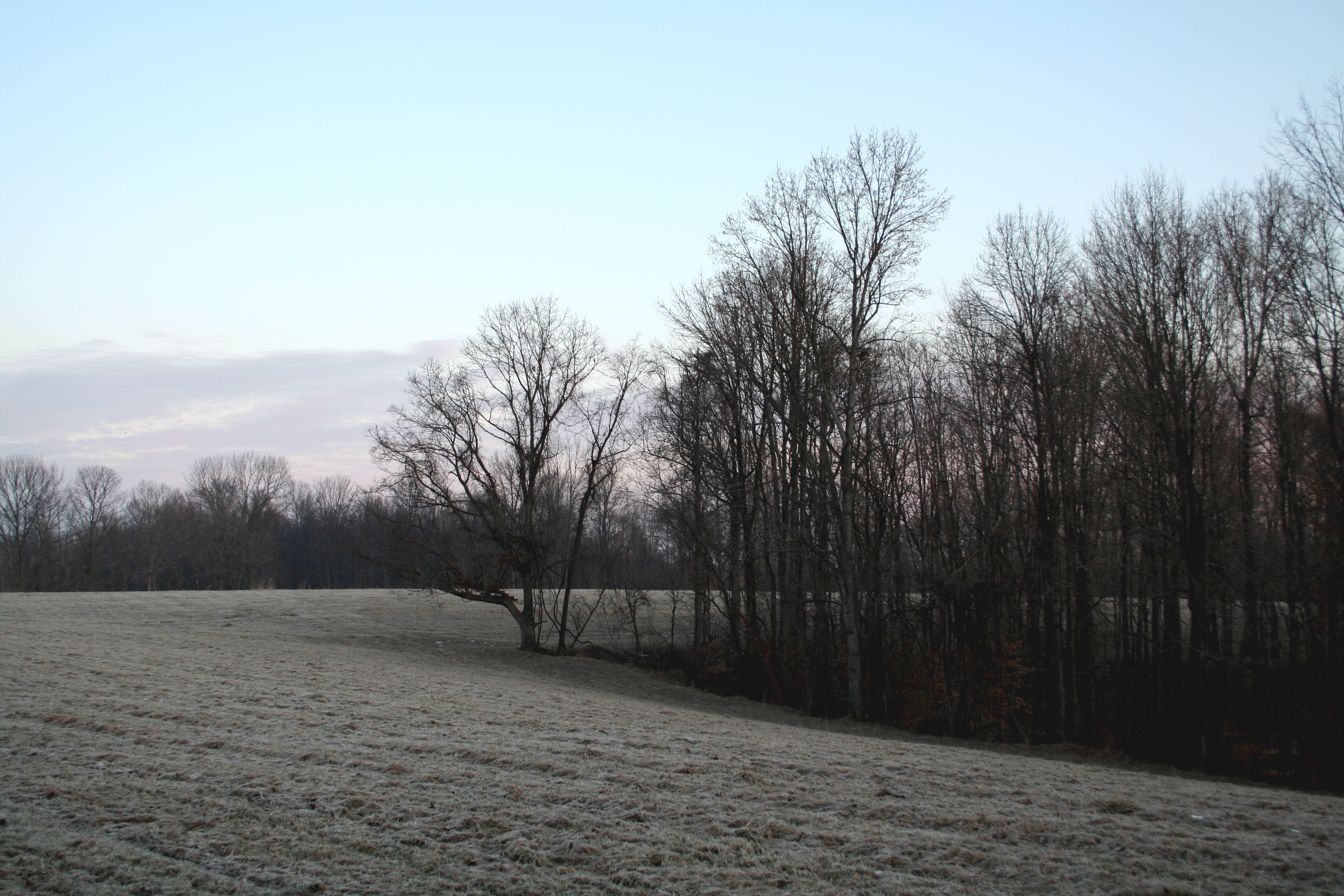
I must admit, I enjoyed the taste of a winter wonderland at the Farm.  My apologies to all of you in Virginia, Maryland, Pennsylvania, New York and Oklahoma who are still dealing with a super abundance of the white stuff and are sick of it.  We only had a couple of inches there in south-central Kentucky, starting the third day, and it was gone by day six.  Temperatures in the teens and low twenties ensured our winter working visit was sufficiently wintry, requiring the donning of insulated coveralls, vests, multiple hats and gloves for all the outdoor work, but thankfully the snowfall was limited.

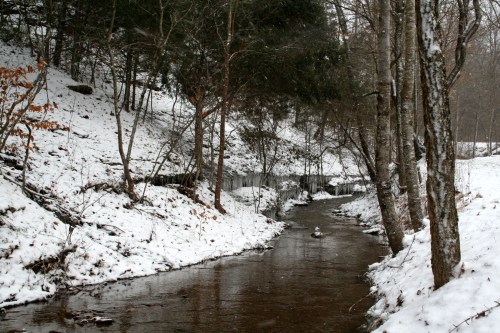
The cold kept my photo-documentation of this trip to a bare minimum, I’m sorry to say.  It was too cold and I was too busy to set the camera up for self-shots; too cold also, to get the Bear to lend a hand and work the shutter.  So it goes.  I managed a couple of stomps around to take a few pictures of the wintry roads, the house and shop, the icicle-adorned creek, the snow-frosted pastures and pond, but of the projects and work accomplished, nothing.

I’ll do better next time.  But the work got done, pictures or no.  It was a very good Farm visit.

I had hoped for dry weather and lightly frozen ground so I could chop down the summer’s growth on the pastures with the tractor and bush hog – work that should have been done in September or October, but we had fences to build and gates to hang in September, so the pastures hadn’t been mowed since spring.  Not the end of the world, pastures don’t always need mowed to do well; but the cover is so thick and ungrazed on mine, the dry matter left standing at the end of the growing season is too substantial to break down without some mechanical shredding.  I figured a winter mow, though unorthodox,  might work.

I got lucky this trip.  Conditions weren’t perfect, but I did get all but the little 3-acre west pasture mulched down, ready for the rains to work the chopped material into the soil where it can feed my micro-livestock there.  Unchopped, untrampled forage held above the soil by height or bulk, may take several years to decompose, even in Kentucky’s rain-blessed environment.  Soil contact is essential, and the bush hog does a fabulous job of shredding the grasses and pushing them down to the surface for the new grasses to grow through.  Grazing animals would, of course, be the ultimate pasture management tool, but until I’m there full-time, my little tractor must suffice.

It was a good opportunity to observe the wet areas between the ponds, where surface moisture persists in scattered depressions in all but the driest months.  The folks had mentioned standing water in the fields over the years, but I’d not had the chance to assess the boundaries of where this occurs; this trip I was able to see the acre or so of what may very well be permanent wetland that appears to be spring-fed, draining slowly to either side of the crest of the top pasture into the two ponds.  I will stake it out in the spring when we are back, and let it alone to see what it does through the seasons.  It may be an ideal place for a wetland hedgerow of native plants; though it would take some pasture out of production, there is much benefit to be derived from the diversity of another plant community on the farm.

Before I could start the tractor work, though, we had to drain the hydraulic fluid as it checked white and foamy, indicating water had seeped in.  I believe Bobby had left Jack out in the rain last Fall – old tractors like this aren’t weatherproof, and water will get in unless the housing is covered.  So we did that, along with the rear differential, because the PTO wasn’t disengaging properly and we thought it might be a fluid problem.  It was.  The shop manual sent us on a goose chase for the rear differential’s check plug that ended up being a hidden screw on the side of the housing behind the brake pedals, which had to be loosened and moved out of the way to access the screw.  It didn’t appear to have been opened in a long time.  We drained approximately 6 gallons, and the book said that was the capacity; but filling it took only 5 before the fluid started coming out of the check hole.  The front end loader added to the system probably accounts for the difference.  We think it was overfull the entire time, getting filled to the recommended amount without checking the level, which would explain the constant leakage underneath and the PTO malfunction. 

So a day of tractor maintenance, and evenings cleaning and setting up the shop was time well spent.

Heading up to Louisville on Thursday for our flight home, we had no idea that Dallas had received a foot of snow and the airport had cancelled all incoming flights.  With no TV, no Internet, no national newspaper, and just radio news, which focused on the snow being dumped on the Mid-Atlantic but never mentioned Dallas, it didn’t occur to us to call and check before we left.  So back to the Farm we went, and the next morning’s flight was cancelled too, leaving us with a flight out on Sunday at the earliest. 

I confess I was not very upset to have to return to the farm for another couple of days.  My job list for our Spring trip includes repainting the corral panels that have been sitting out rusting for 8 years or more, so Friday afternoon I was able to get them all moved down to the shop, ready for sanding and rust treatment and painting come April.  Saturday was cold and cloudy with scattered snow flurries, but I bundled up in my insulated coveralls and spent the day taking down (finally!) the barbed wire lanes that surrounded the pond and corral.  Posts will get pulled next visit, and mowing should be infinitely easier without the fences and gate setup that was no longer in use and badly situated to begin with.

Returning to San Diego on Valentine’s Day, the captain announced our descent into Lindbergh Field around 5 pm and noted the temperature:  72 degrees.  I smiled, and thought of the frosty fields, snow-kissed woods and frigid temps we’d just left, and of all the good work we got done.  And the little farmhouse, buttoned up behind the gates and fences, with lights that come on in the evenings, waiting for our return.  I can’t wait to get back.

Farm Trip!

We’re flying out this morning for a few days at the farm to knock out some maintenance projects that I’d rather not leave until Spring.

I know, it’s the middle of winter.  And yes, there’s a whopper snowstorm of epic and historic proportions clobbering the Ohio Valley and mid-Atlantic but I am hoping the worst of it will pass well north of the farm.  It’s snowing there right now, but only lightly.  Nothing like what will fall further east.  

I had a tip-off that there would be a dry spell for our location into next week which is turning out to be innaccurate, but you have to make travel plans and reservations in advance and so, this was the best I could do.  I was hoping I could do some off-season pasture maintenance.  We’ll see.  So far the 10-day forecast on weather.com predicts 30-40% chance of light snowshowers mid-week; not exactly a dry spell.  I’ll keep my expectations low and do what I can, weather and ground conditions permitting.  There’s always something that can be done.

Bear will be adding extra dead-bolt locks to house and barn doors, and we were excited about the arrival of my newest piece of work equipment, a 6X4 Diesel JD Gator, ordered from the local dealer and scheduled to be delivered on Monday, but it has been delayed.  So we’ll have to pick it up on our Spring trip. 

This little rig will be my salvation when I get there, toting me and my tools and fencing supplies etc up the hill and around the pastures like nothing else can.  I’m down with getting lots of exercise walking everywhere but the hill road is a steep quarter-mile and the pastures are flung out like a giant’s hand; I’ll appreciate a vehicle that can carry a load and go everywhere without batting an eye and with minimal impact.

So, wrapping up here at Bear and Thistle West and heading east to the Farm.  Blocks for Wall #2 are stacked and ready for my return and the three-day weekend that follows.  Good work, and I’m looking forward to all of it.  

I’ll update on Friday when we return; stay safe and warm, all.

Container-grown broccoli

I’m only feeding the two of us, so a few container-grown broccoli plants are gracing our table with plenty of goodness this winter.

The brussels sprouts will follow close behind; I’m anxiously awaiting their bounty.

On the way down to the mailbox yesterday I stopped to chat with our neighbor Les, who was conversing with another neighbor from up the street aways, an older gent named Bill, who it turns out is also a container vegetable gardener.  Those of us with small yards must grow what we can, where we can.  Bill was interested to hear of my terracing project and rued the fact his backyard hill faces north, which rules out growing vegetables there.

I advised him to tear up his front yard and plant his vegetable garden there.  I was not kidding.  It was good to talk with someone who goes to the same trouble I do to grow a little bit of food for their table.  Here in suburbia we are a dying breed. 

My passion for growing and putting by my own food is a thing of wonder to my neighbors, friends, and coworkers.  I am born to it, and have felt this urge since I learned to cook and garden and can at my mother’s elbow; it is purt’ near genetic, as far as I can tell.  And that’s just fine by me.  Keeps me out of the atrocities they call grocery stores.

It’s been a good week of projecting, I’d say. 

This photo, taken yesterday around 4 pm, captures the end result of a lot of really hard work.  Yes, that is a wine glass in my hand.  I am celebrating, and trying to get the knot behind my right shoulder blade to relax.  Not only is the first wall now at full height, but the terrace bed it contains is now cut back into the hill full width – five feet, plus another foot for where the second wall will lay. 

That’s a 35-foot long wall, plus the rounded corner.

My next step is to order the block for wall #2 and get it moved down onto the first bed, which will be my work surface until the next terrace is complete.  Then, once I’m done tromping all over it and the blocks are well-tamped and settled, I’ll remove 16″ or so of the granite fill in this first terrace and replace it with a topsoil/compost mix for some serious vegetable gardening.

But first, I’m enjoying an enormous feeling of accomplishment, and letting my bones rest.  However, do not be alarmed at the tonnage of concrete and dirt moved and the manual labor involved; I work slowly and steadily and pay particular attention to ergonomics, keeping loads low and close and engaging core muscles before every lift.  And I take lots of rest breaks.  So other than being stiffer than usual and this darned knot behind my right shoulder, I’m no worse for the wear after working like a mule for the past week.

Surprisingly enough, moving the block around was not the most grueling part of this job.  If you look to the left of my head in that first picture, you’ll see a pile of plant material perched up on the top edge of the hill.  It doesn’t look like a huge pile, but let me assure you, it is. 

If you will compare the first picture taken when I started this project to this post’s picture, you will notice a lot of the ice plant that used to cover this hill from top to bottom has been cut off and removed.  It looks all neat and tidy now, like I just sliced it off with a laser beam and Poof! it went away.  Oh how I wish. 

Left undisturbed for more than a decade, the ice plant was thriving atop a foot-deep layer of partially decomposed older plants; the leaves had turned to crumbly black humus, but the stems all needed to be cut somehow.  A swath at a time, with the help of my trusty loppers and my indespensible garden trugs, I got ‘er done.  One trug-load at a time cut, pulled, and trudged up to the top of the hill.  My legs feel like I climbed Mt. Everest.  And my arms are pretty darned tired, too. 

Really now:  with leisure-time activities like this, who needs a gym membership?

Taming the back hill

This is one of those projects I’ve wanted to tackle for a long time.

All the backyards along our side of Redlands Place perch atop the rim of a spacious and wild chaparral canyon, with half the property in back of the houses comprising a rather steep hill that merges into the hillside below.  Most of our neighbors have installed pools or decks to extend their back yard space; from the beginning I planned to terrace our bit of hillside into garden beds, to take advantage of the south-east exposure.  But there were challenges.

The previous owner had planted two bunches of invasive pampas grass in the bottom corners and a variety of ice plant (also very invasive) along the remaining slope.  The pampas grass had grown into impenetrable tangles of vegetation nearly 20 feet across at the base that took many hours of labor back in 2002 to remove.  Since then I built a rough-hewn set of free-form concrete stairs to the bottom level for access, but with the exception of removing the pampas grass clumps, we’d done nothing to improve the hillside.

But the time has finally come to tame the hill.  My container garden that takes up half the flat part of the backyard needs to expand into a permanent home, and I need room to stage materials for the fence rebuild project.  So energized by my project plan, I inhaled deeply, took measurements, and ordered enough interlocking block to build the bottom wall for the first terrace bed.  The block and half-yard of gravel was delivered Friday, amidst pouring rain and occasional hailstorms.  My goal is to complete the first retaining wall before we leave for our Kentucky farm trip on 6 Feb.

Here is what the hill looked like before I started:

The brown line of dead plants across is the ice plant I pulled out about a month ago, that had grown down from the bottom of the stairs to the fence (out of the picture at the right) at the bottom property boundary.  In one year.   Ice plant is a very vigorous, succulent invasive from South Africa, growing up to a meter in one season and rooting anywhere a stem touches the ground.  Since it needed to dry out a little before running it through the shredder to make into compost,  I threw it uphill as I pulled it.  This current project started with pulling all that half-dried material down to the bottom, and moving it laboriously up the stairs to my utility yard one forkful at a time, where the huge mound of it awaits an afternoon’s work with Chewie, my stalwart Troy-bilt chipper-shredder.

160 Keystone Legacy block will build a 35-foot long, 3-foot high wall.  I spent the afternoon and part of Saturday morning imitating a small draft animal, first carting trugs of gravel down to the bottom and then 4 blocks at a time on my garden cart from the driveway to the edge of the hill in the backyard.  I’d already dug the footer trench for the wall (see first photo) and laid a couple of block when I realized I needed to somehow get all of them down to the bottom before I could really start serious wall building.  So Sunday morning, that is what I did.

My method was what I’d call “ghetto.”  One woman, 160 blocks needing to be moved down 20 feet of ice plant on a 45 degree incline.  Carrying them down the stairs one by one was out of the question.  So I gerry-rigged an old half sheet of plywood backstop against the chainlink fence at the bottom, padded the whole affair with prunings of ice plant, and started rolling 55-lb blocks like bowling pins.

It worked.  No blocks were damaged in the making of this blog post.  And at $3.50 apiece, that’s a good thing.  Man, it was a lot of work, though.   I managed to get three at a time rolled down without hitting each other, then had to clamber down the spongy bed of ice plant to stack them safely out of the way, and climb back up to the top for another round of ghetto block bowling.

After a bit of rest, Sunday afternoon I started laying the first course.  This is the most important element of the wall, these first blocks; they must be perfectly level or everything above will turn out badly.  Following instructions, I laid a couple of inches of sharp gravel down, then set the block.  Ever laid flagstone or brick?  Levelling on a bed of sand is tricky at best; on gravel, near impossible.  So, I cheated a little and used a bit of decomposed granite fill dirt overtop the gravel, to get the level right. 

It’s turning out well.  I’ll backfill with gravel and lay weed-barrier cloth before pulling the dirt down as the courses go up.  More ice plant removal will be required.  Lots of compost to be made, hooray. 

Garden beds are dancing like sugar plums behind my eyelids.  I can’t look at that hill without seeing all three terraced beds completed and a marvelous Spring garden emerging from the compost-enriched soil.

The projecting begins

Things are getting busy here at Bear and Thistle West.

It finally sunk in over the holidays that my time here is short, and if I don’t plan things out I will never finish all the projects I’ve been wanting to do before I have to leave. 

The truth is (and I’m ok with this, really), if I don’t do them, they won’t get done.  Things like painting the house inside and out, replacing the falling-down back fence, rebuilding the termite-eaten pergola over the back patio, re-laying the cracked flagstone pathways over concrete, re-insulating the attic.  Stuff that needs done before the house is sold, several years down the road – basic material condition items that will ensure it gets a fair price and we’ll get as much equity out of it as possible.

Quite a lot of work, you might say, and you’re right.  But I’m loathe to pay someone to do a job I can do myself, and I actually like building and fixing stuff, so I’ll hire out only the most difficult tasks and perhaps the ones I cannot get to for lack of time.

We bought this little stucco and tile roof house nearly 11 years ago, long before I figured out I was a farmer and needed more than an eighth of an acre to be happy; until 4 years ago I thought I had years to tackle all the basic material improvements any 25-year-old residence needs.  After two long deployments and much time on the road, my projecting window is now a mere 22 months long.

Yikes.

So, the time has come to do some serious planning.  And I found just the thing:  a Gantt chart on Google Docs that I can access anywhere, and update and modify as I go along.  It took a few days to populate, and I’m sure my time estimates will need to flex as projects unfold, but what a great help it is, to be able to map out a proposed schedule over the next two Springs, Summers, and Winters (and one Fall), lining up outside work with long daylight months and reserving inside work for winter months.

Will I get it all done?  Maybe, maybe not.  But check it out – I am certain to accomplish more with a plan that lets me focus on one project at a time, knowing that “all that other stuff” will have its time; and the incentive of keeping to a schedule is just the motivation I need to use every little scrap of time gainfully, whether I’m able to stick to the project schedule or not.

I’m stoked.  And I love being stoked.  It’s one of my favorite feelings in all the world.

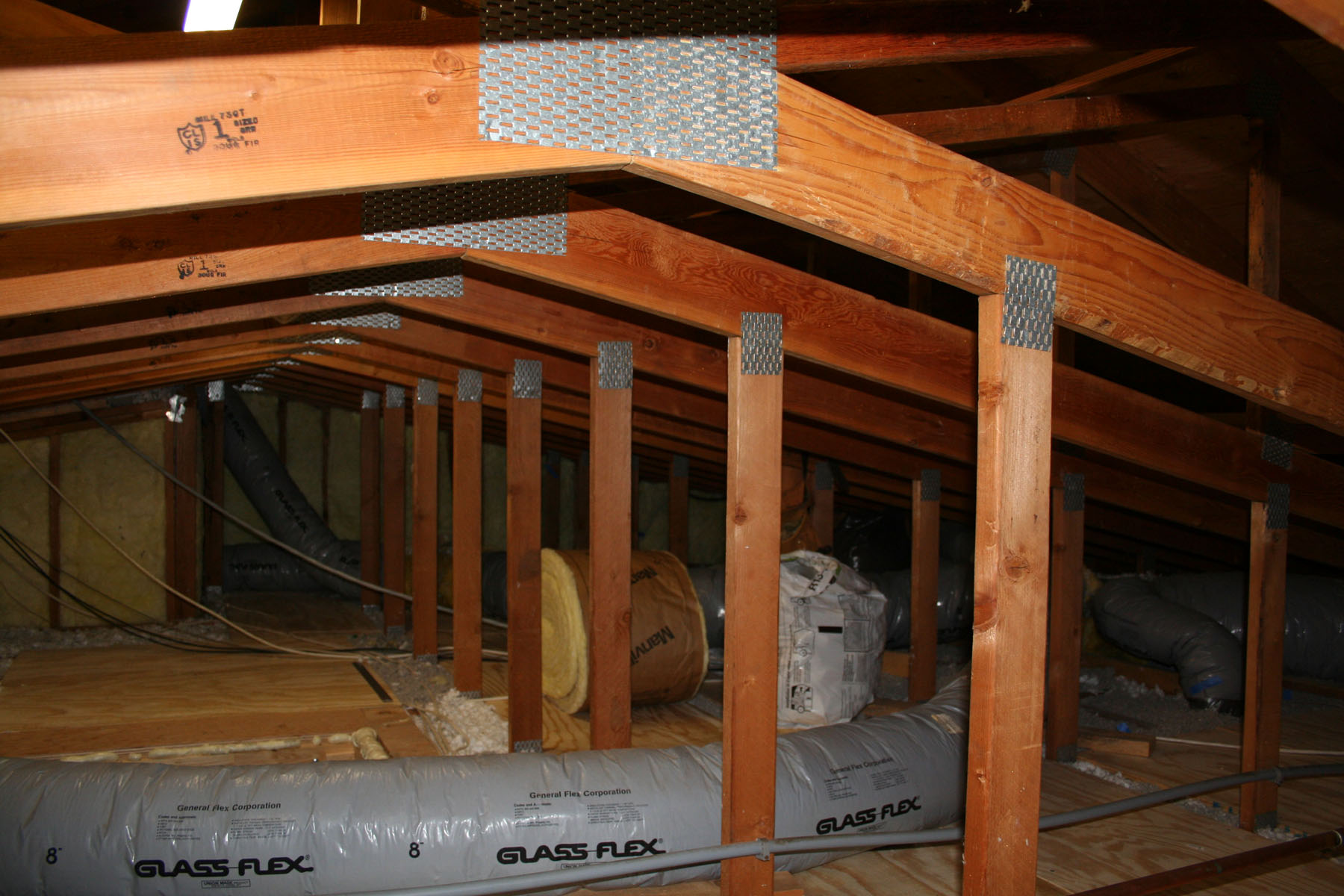
Project #1, Attic Decking and Re-insulation, evolved into a two-phase job.  It kicked off with the installation of a pull-down attic ladder done back in November, something I’d threatened to do for years, to make the house attic accessible for plumbing repairs and future ventilation upgrades.  Every time we had to drag the ladder in from the garage and climb up through the little access hole, I swore, loudly.   

The ladder had to be framed in offset of the ceiling joists to center on the hallway; a pain in the neck to say the least.  Bear was a great help with the sawzall and demolition, leaving the framing of the opening to me, and we teamed up to get the ladder hung, one person above and one below.  After I hung a couple of fluorescent lights from the trusses I could see where to lay down plywood decking so we weren’t just scrambling around on joists and rafters, and it quickly became apparent that the blown-in insulation was pitifully inadequate. 

So after the holidays I started the decking in earnest, which required adding more insulation, one section at a time, moving about on hands and knees or ducking under the waist-high truss members.  6 sheets of plywood sawn in fourths and five bales of cellulose insulation later, I have a fine storage attic, all holes sealed with foam, plenty of space to walk around, and insulation restored.  The cathedral ceiling portions of the attic, though, still need work.

Which will be Phase Two, done at a later date, because my Project Chart has me starting the back hill terracing and retaining wall construction this week.  I’d like to get that done so my Spring garden can go in those new growing beds, which will open up the backyard for the summer’s fence rebuilding project.

It’s good to have a plan.